
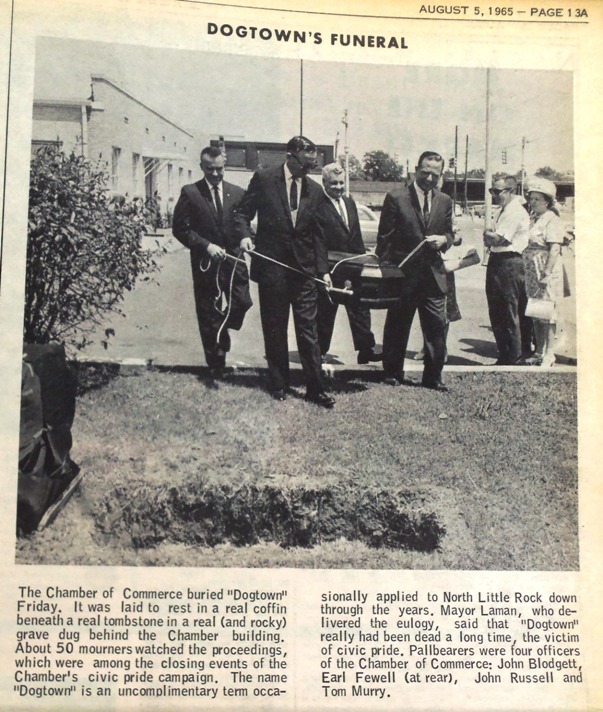
Dogtown Laid to Rest
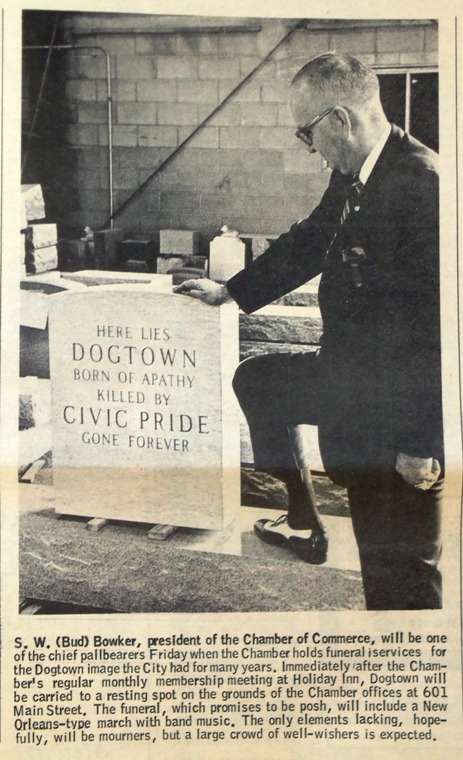
Tombstone Found
A City of Many Names
North Little Rock is a bundle of small towns with names like Argenta, Baring Cross, Levy, Rose City, Amboy, Dark Hollow, and others. Throw in, too, 19th century the names of DeCantillon and Huntersville. Each has a history of its own that rests as much on legend as fact.
Before the railroads took hold economically in the 1870s and 1880s, the north side of the Arkansas River nourished a smattering of homesteads and plantations down river. Agriculture, timber, hunting, mining, and two ferry terminals provided livelihoods in the locale, identified on Civil War era maps as “The north side of the Arkansas River opposite Little Rock.”
The river offered blessings and curses. Although enriching the soil, flood waters rose almost annually to threaten life and property in the swampy terrain below Big Rock Mountain. The Flood of 1833 surpassed the more famous flood of 1927 but caused less damage due to the sparse population.
Any dream of founding the town of DeCantillon, named for Richard DeCantillon Collins, who surveyed the 100-acre tract, ended in 1840 under water. The town existed only on paper as a plat filed with the Pulaski County clerk in 1839. Riverfront Park between the Main Street and Broadway bridges now occupies the portion of the ground that hasn’t washed away.
The Memphis and Little Rock Railway, the state’s first railroad to operate, built a depot and shops near the river’s edge in the early 1860s between the Main Street and President Clinton Library Bridge. After federal troops captured the railroad facilities and Little Rock in September 1863, the north shore was designated by the U.S. Army as Huntersville. The name also appeared on maps and railroad timetables from the mid-1860s until 1871.
Historians have disagreed on the origin of the name of Huntersville. Some maps dating back to the 1820s referred to the north side as “French Hunters” or “Hunters,” denoting the plentiful game in the area. Earlier writers claimed without verification that the ferry terminal across the river from the Point of Rocks (the “little rock”) was known as “Huntersville Landing” in the late 1820s. However, the name wasn’t recorded in any documents prior to the mid-1860s. The best explanation is that it derived from William Hunter, the
U.S. military supervisor of the railroad during Union occupation.
In 1866, the heirs of Thomas W. Newton Sr. surveyed and platted a townsite they named Argenta, a derivation of the Latin word for silver. Newton, a politician and entrepreneur, had served as president of a company that worked the Kellogg silver mine about 10 miles north of the river. The boundaries of the plat, filed in the clerk’s office in 1871, stretched north from the river to just past what is Eighth Street today, and east from Main Street (Newton Avenue) to Locust Street (Woodruff Street).
Spurred by railroad construction, Argenta and Baring Cross attracted immigrants looking for work and grew tremendously in the late 19th Century. In 1873, the Cairo & Fulton Railway, with financing from the Baring Brothers of London, built the Baring Cross Bridge, the first permanent span over the Arkansas River. “Cross” in the name referred to the Coat of Arms of the family of Thomas Allen, president of the Cairo & Fulton.
Deriving its name from the bridge, the Baring Cross community along Pike Avenue grew economically with construction of machine shops and a roundhouse by the Cairo & Fulton, which merged with the St. Louis Iron Mountain and Southern Railway in 1874. Three hotels and a host of businesses sprang up on Pike in the 1870s and 1880s. Incorporated as a municipality in 1896, Baring Cross administered its own government until North Little Rock annexed it in January 1905.
North of Baring Cross on the Fort Smith highway, Ernest Stanley opened a grocery and dry goods store in the early 1890s. Near a campground north of the gap between today’s Scenic Hill and Cherry Hill, Stanley sold his goods to farmers staying overnight on their way to markets in Little Rock and Argenta. Morris Levy, a Jewish merchant in North Little Rock, had staked Stanley $50 and extended a line of credit to get his business off the ground. In return, Stanley named Levy after his benefactor when a post office was
established about 1900.
In 1917, Levy incorporated as a municipality to avoid annexation by North Little Rock. W.F. “Flake” Stanley served as the town’s first mayor for eight years. He didn’t wish to run for a fourth two-year term in 1923, but the townsmen elected him anyway. In all, Levy had eight mayors with one – J.H. Fretwell – serving three different times. Fretwell, who ran a service station and store at Pike and Camp Robinson Road, was also Levy’s last mayor before North Little Rock annexed it in 1946.
Rose City to the east of downtown North Little Rock never incorporated a town government prior to annexation by North Little Rock in 1946. According to tradition, Hassell Prothro named the area after his daughter Rose. However, others said the name came from the Rose City Cotton Seed Oil Mill, built in 1902 by developer Justin Matthews and businessman James P. Faucette. The Tie Plant community in Rose City was settled by workers at the adjacent Ayer & Lord creosote plant, now Koppers Inc., which began making rail ties in 1907.
Two historically Black neighborhoods – Military Heights and Dark Hollow – were marketed to Black families around 1900. West of Main Street from 21st to 29th Street was known as Military Heights, a name linked to the construction of Fort Roots. Dark Hollow, east of Main between 13th and 20th streets, derived its name from a primeval swamp in the lowland flood plain south and east of the ridge on which Park Hill was built.
Justin Matthews oversaw development of Park Hill in 1922. He also built the lakes and dams in Lakewood in the early 1930s and the Old Mill in 1933. His heirs completed his vision with construction of Lakewood after World War II.
The Dixie community, a historically Black neighborhood near Rose City, was dedicated in 1924, but didn’t grow much until the 1940s. Many of its early residents worked at the Dixie Cotton Seed Oil Mill. Pike View, north of Park Hill, was a Justin Matthews development in the 1920s. Amboy, which appeared on railroad maps in the early 1900s as Amboy Switch, developed in the 1950s. Other housing developments in the 1950s included Glenview and Meadow Park in eastern areas of North Little Rock. The Indian Hills and Overbrook neighborhoods, east and west of JFK, date to the 1960s. The Bunker Hill and Chimney Rock developments came in the 1970s.
–Cary Bradburn
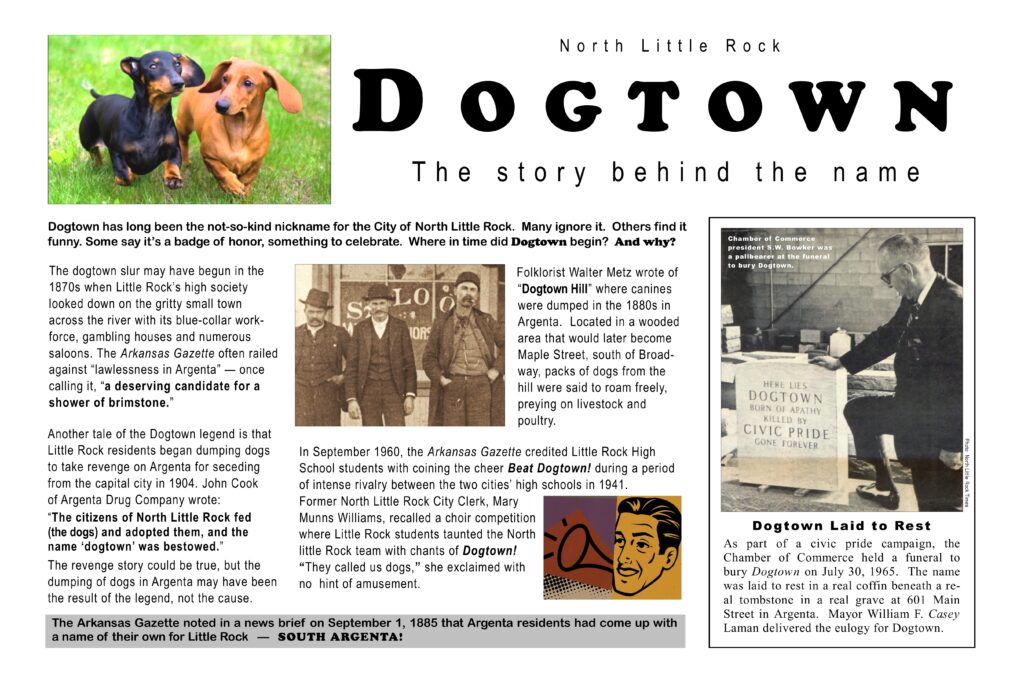
The Story behind Dogtown
The North Little Rock Chamber of Commerce tried to kill it in 1965 with a mock funeral and burial.
Others had long tried to deny it or ignore it, but it wouldn’t go away.
Some got mad and a few fought over it.
Many laughed about it.
Legend tried to explain it.
“Here lies Dogtown – Born of Apathy — Killed by Civic Pride — Gone Forever,” the Chamber’s replica tombstone declared.
Except, dogtown didn’t die.
Vandalized with graffiti in 1973, then stolen in 1975, the Chamber’s tombstone was found in 1983 south of the flood wall. Alderman Bill Harris discovered it in weeds near a building by the river. Notified by Harris, City Clerk Jackie Neil dispatched a Street Department crew to move the heavy tombstone to City Hall for safekeeping. Since 2013, it has been archived at the North Little Rock History Commission.
Dogtown, it seems, has always been a part of North Little Rock vis-a-vis Little Rock.
Perhaps a couple of generations had to pass to lessen the sting born out of rivalry between the twin cities. Today, old wounds have mostly healed and people are embracing the historical epithet with pride, as something even to celebrate.
Its story is generational, the origin shrouded by time.
Dogtown as a derisive nickname for North Little Rock appeared in the press relatively late in the telling. So far, the earliest known use of it in print comes from an Arkansas Gazette column on September 11, 1960. The writer credited Little Rock High School students with inventing the insult as a new cheer (Beat Dogtown!) in 1941, when the basketball series between the two cities’ white high schools had reached peak intensity.
Mary Munns Williams, city clerk (1989-2000) and a 1942 graduate of North Little Rock High School, recalled in a 1995 interview that Little Rock High students taunted their northside counterparts in the early 1940s by chanting
“dogtown” and “calling us dogs.”
She never found any humor in it, though she was fond of a dogtown legend older than the one told in the Gazette.
Munns Williams, like others of her generation, knew the story dating back to the early 1900s. According to this version, people in Little Rock (more particularly, saloon patrons) rounded up strays and either released them on the free bridge leading into North Little Rock, or dumped them on the north side. The motive, the story goes, was revenge after North Little Rock separated from Little Rock in 1904.
Jackie Neil, North Little Rock historian and city clerk (1968-89), called the motive “doggish retaliation” and was proud to say that “benevolent residents found food, shelter, and a haven for all the animals.”
Writing in the 1985 winter edition of the Pulaski County Historical Quarterly, Argenta Drug Company owner John Cook gave a similar account: “The citizens of North Little Rock fed the dogs and adopted them, and the name ‘dogtown’ was bestowed on North Little Rock.”
While the retaliation story is the most popular version, there’s yet an older dogtown yarn that goes back possibly to the 1880s.
Walter Metz of Baring Cross, a local historian and storyteller, wrote in the North Little Rock Times in 1980 that Little Rock residents chose “Dogtown Hill,” a heavily wooded area on the north side, “as a dumping ground for their unwanted dogs.”
Echoes of the later retaliation story appear in Metz’s version. “The dogs would be turned loose in these woods and many would have starved to death had it not been for kind-hearted residents in the area,” he wrote.
He described Dogtown Hill as “a promontory of pure dirt, about two block square at the base and perhaps 60 feet high at the peak.” The hill, which Metz speculated was an ancient river deposit, extended from Orange Street to Main Street, between Washington Avenue and Broadway.
Maple Street “was cut through the hill at the time the free bridge was built” in 1897, he said.
Metz may not have been correct about the date of the street cutting through the hill, however. The 1886 Sanborn map shows Maple Street as already constructed, running north from Arkansas Avenue for several blocks.So his version of the story apparently predates the free bridge by more than a decade.
How the dog-dumpers crossed the river, Metz didn’t say. A plausible option would have been the Junction Bridge, which opened in November 1884. It had a plank for foot traffic, alongside the railroad track. The river did get low during dry spells, low enough for someone to cross on horseback or wade across with a dog.
Over time, Metz said, Dogtown Hill “was cut away a piece at a time” until the last vestige of it disappeared in the 1950s. “My mother (Winnifred Metz Seymour) once remarked: ‘We just dug ourselves out from under that (Dogtown) name,’” he wrote.
Metz didn’t opine on how the Dogtown slur came into being. The motive for dumping dogs was that they were unwanted. The abandoned dogs, Metz noted, “reverted to their wild state and roamed around in packs, becoming a menace to livestock, and poultry of nearby farmers. Some of these dogs mixed with the local coyote population and produced ‘coy-dogs,’ a still greater menace.”
Such fear would have made an impression on popular memory. Although Metz’s dogtown tale likely contains as much folklore as history, he heard many stories while growing up in the early 1900s. This one may have been among the earliest explanations for the origin of dogtown on the north side.
The genesis of the slur may have been Argenta’s working-class, immigant roots. Three major railroad companies converged on what newspapers described as a sleepy hamlet in 1871. As the gritty town of trains, factories, and mills grew in the late 1800s, it acquired a rough-and-tumble reputation for drinking, gambling, vagrancy, and prostitution.
Such “lawlessness” inflamed the moral wrath of editorial writers in Little Rock. Larger, wealthier, and more established, Little Rock had similar issues with vice, but assumed the airs of greater sophistication. Argenta on the
other side of the river was the hick neighbor to look down on.
This created resentment, expressed in an Arkansas Gazette news item on September 1, 1885, stating that Argenta residents had come up with a name for Little Rock: South Argenta.
Neither dogtown as a slur nor the dumping of dogs are unique to North Little Rock, though details of the story are. Is it legend? Did folks really dump dogs? Does it matter? We can laugh about it and revel in the stories. Wear dogtown like a badge of honor.
Dan Conaway, editor of Out of Dogtown, a 2022 memoir of a well-liked North Little Rock character named Jackie Lackie, summed up the dogtown insult by asking: “Would you rather be known as a place that dumps dogs, or
as a place that takes them in?”
–Cary Bradburn