Steam Engines give way to Diesel Power
In the early 1930s, the Great Depression ravaged the financial health of railroads.
The Cotton Belt shut down passenger service to North Little Rock and never restored it.
MoPac and Rock Island slipped into bankruptcy, forcing layoffs for hundreds of railroad employees in North Little Rock.
Those lucky enough to keep their jobs worked for 10 percent less.
By the mid-1930s the economy was improving and the railroads had reorganized to carry on with their vital task of moving people and freight.
Deciding to invest more in passenger service, railroad companies started rehiring many of their furloughed workers at full wages. The object was to upgrade their services and appeal to the public.
With riders’ comfort foremost in mind, MoPac called back shop workers to install air conditioning in all of its Pullman sleepers and dining cars.
Among the first air-conditioned trains during the 1930s was MoPac’s Sunshine Special. Inaugurated in 1915 by the Iron Mountain, it ran out of St. Louis through North Little Rock to Texas and was regarded as MoPac’s signature train.
With air-conditioning, the Sunshine Special proved even more popular. “It’s 70-degrees in the Sunshine when it’s 100-degrees in the shade,” MoPac advertised.
Another MoPac train of note was the Rainbow Special that started in 1921 on a route between Kansas City and Central Arkansas. It was, however, the last heyday of the Iron Horse, as the muscular, bellowing steam engines were called.
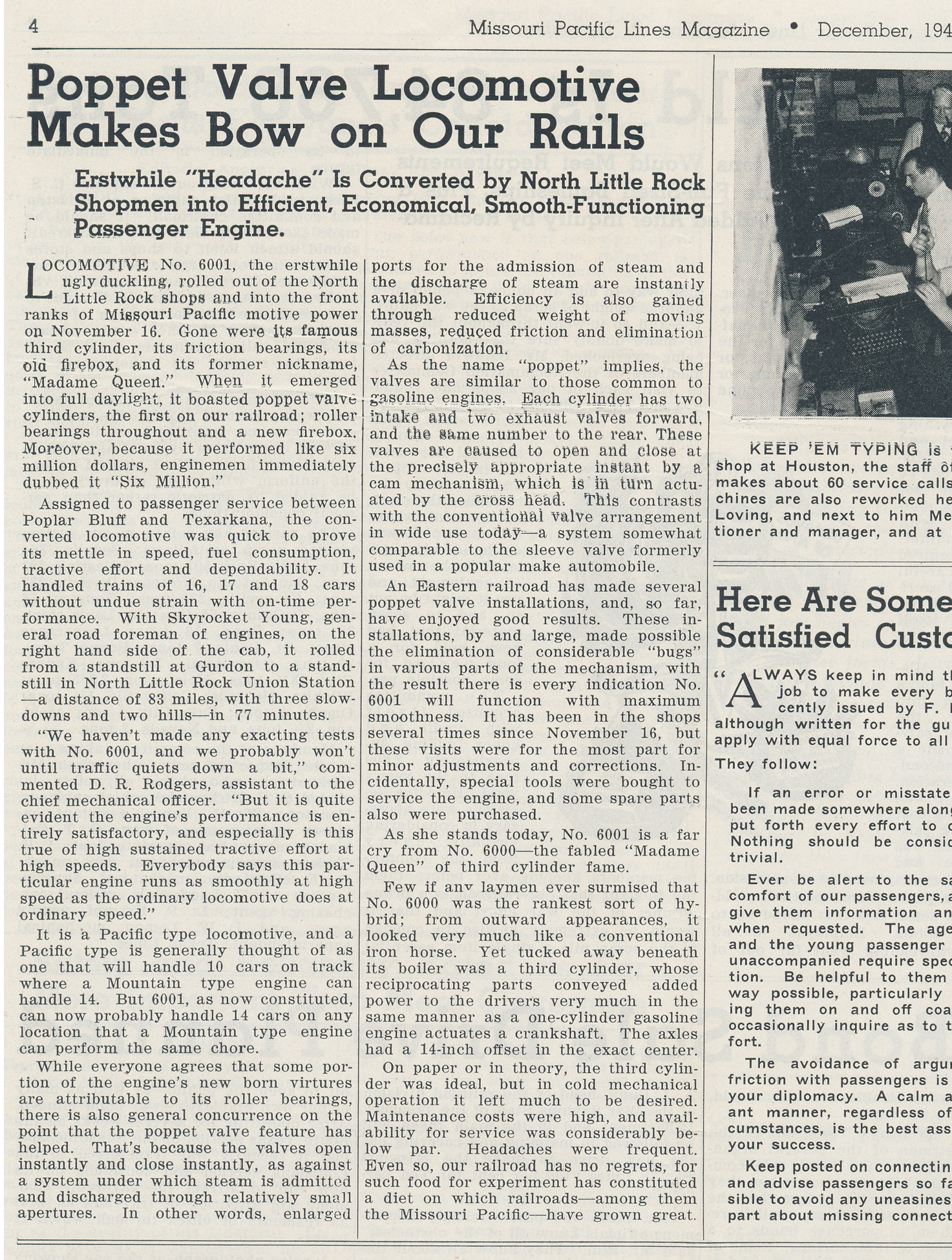
In the 1940s, MoPac and Rock Island began replacing their old oil-based, coal-fired steam engines with high-speed diesel-electric locomotives called streamliners.
Some of the steam engines remained in service until the mid-1950s, but the future had arrived, and they were not part of it, except as relics of a nostalgic past.
Known collectively as Eagles, MoPac’s passenger streamliners included the sleek, diesel-powered Texas Eagle, launched in 1948 between St. Louis and Texas. At first it co-existed with the Sunshine Special, then replaced it in the mid-1950s.
The Rock Island, despite financial issues, also enhanced its passenger service, gaining riders through Arkansas with its diesel streamliner Choctaw Rocket between Memphis and Los Angeles.
Mike Adams of North Little Rock, a noted railroad historian, cast a wistful eye on the demise of the steam engine: “Gradually all traces of steam operation were removed. The great dirty coal chute and the huge, smoky, fascinating roundhouses were torn down.”
Yet life and railroading went on.
Railroad companies revamped their shops for diesel engines. Boilermakers and blacksmiths became electricians and machinists.
More changes came in the 1960s, with the decline and elimination of passenger trains, until their revival by AmTrak.
–Cary Bradburn
Fire Destroys Baring Cross Shops
A fire about 2 a.m. on September 25, 1900, destroyed the St. Louis, Iron Mountain & Southern Railroad shops at Baring Cross.
Some 600 workers were idled by the conflagration, which burned the machine shops, car shops, mill shops, six locomotives, and 15 freight cars.
A 25-stall roundhouse, built in 1890, and offices were not damaged.
Other Arkansas cities, including Beebe, Bald Knob, Van Buren, and Texarkana made bids to have new shops built there.
However, the Iron Mountain soon announced it would rebuild larger and more modern shops at Baring Cross and employ up to 2,000 workers.
The railroad preferred the central location of Baring Cross.
In early 1901, railroad officials announced a $500,000 budget to rebuild. The Little Rock Board of Trade also pitched in another $100,000 to keep the shops locally. By mid-1901, newspapers reported that reconstruction was “progressing nicely,” despite a walkout by bricklayers.
A new machine shop building of red brick, nearly 330 feet long by 135 feet wide, was being built. This included a boiler shop, capable of handling 24 steam locomotives and equipped with a 65-ton crane to lift any locomotive in the shop.
Also under construction were blacksmith shops of 100 feet by 200 feet, a power house of 82 feet by 138 feet, a car repair shop of 80 feet by 300 feet, plus a coach shop and a paint shop, each to be 200 feet by 100 feet.
All of the new buildings were constructed of red brick, except the car shop and sheds.
A new 42-stall roundhouse was built in 1912, next to the older roundhouse. They were demolished in the 1950s when the railroad went to all diesel locomotives.
The shops existed for more than 80 years until they were replaced by the modern Jenks Locomotive Facility in 1984.
–Cary Bradburn
Cabooses Replaced by Technology
In the 1940s, Gene B. Lemley supervised construction of Missouri Pacific Railroad’s caboose track station, which included a 10,000-gallon storage tank to
supply the diesel used to fuel caboose stoves.
MoPac brought its cabooses to the facility in the rail yard at Baring Cross for repair, refitting, and restocking.
Although he oversaw the caboose operations, Lemley labored alongside other employees.
“I took the windows out and put the Plexiglas back in,” he recalled years later. “I’d work on stoves. I’d work on the air lines of ‘em. Also we would fix where the water lines would break, the oil line to the stove, and also the conductor’s valve in there where he could stop the train anytime he wanted.”
Cabooses were home and office of the conductor, brakeman, and flagman.
The conductor and brakeman monitored the pressure gauges for the air brakes. From either the cupola on top of the caboose or from bay windows on the side,
they could see the train and watch for any signs of trouble.
Railroads began phasing out cabooses in the mid-1980s and replacing them with electronic monitors that fit over the last car’s coupler. Economics drove the
demise of the caboose. The 35-pound electronic monitors, known as Trainlinks or End of Train Devices, cost about $4,000 each. A caboose ran about $80,000.
Now a relic of the past, cabooses date back to the 1830s when railroads housed trainmen in boxcars or flatcars with shanties built on them. Cupolas were added
in the 1860s.
Some nicknames for the caboose were doghouse, snake wagon, hearse, and bone-breaker.
Before trains had automatic air brakes, the engineer signaled the caboose with a whistle indicating he wanted to slow down or stop. The brakeman in the caboose and a brakeman in the engine would climb out and walk toward each other along the tops of cars, using a club to twist the brake wheels.
When a train stopped, the flagman left the caboose and walked a distance in back with lanterns, flags, and other warnings to safely halt any approaching train.
1942 MP Lines 6001
Ice for Railroads
The Arkansas Gazette wrote on July 24, 1907 about the icing of fruit cars arriving in the state.
The initial icing was at Van Buren and then a second icing at Argenta by Crystal Ice Company, which could produce 50 tons of ice per day. But to meet the demand, ice had to be brought in from Little Rock and Memphis.
Ice plants in Argenta and Little Rock could produce up to 330 tons of ice per day, according to the Gazette.
The railroad needed 4,000 to 7,000 pounds of ice per car.
Forty to 50 cars had been iced the previous eight days – a demand of between 80,000 to 175,000 tons.
Another 1,000 cars loaded with Texas tomatoes were iced at Argenta during the season.
Cars to be iced were spotted alongside the “pony bench”, a raised platform equal in height to the car. Ice blocks conveyed up to the pony bench were then loaded into ice bunkers on each end of the cars.
(Arkansas Gazette 7-24-1907, page 10 column 1).
Train Accidents
UNTIMELY DEATH OF CHARLES YOUNGBLOOD
Charles Youngblood owned and operated the Youngblood Saloon at 924 Newton Avenue (now Main Street) from the mid-1890s until his untimely death on
Christmas Eve 1900 when a St. Louis, Iron Mountain & Southern engine hit him.
Youngblood and a neighbor, Charles Wellington, were walking home from the saloon on the railroad tracks north of the Fort Smith Crossing. The engine was
backing up from the crossing to go to the roundhouse and had no rear lights and didn’t sound its horn or bells, so the men could not have seen or heard it coming
until too late. A coroner’s jury later found negligence on the part of the railway company.
Before leaving the saloon about 7 p.m. on that tragic Christmas Eve, Youngblood remarked to a friend that “this was one Christmas I have kept strictly sober,”
according to the Arkansas Gazette on December 26, 1900.
Youngblood apparently saved Wellington’s life, the newspaper said, when he shoved him out of the path of the engine, but the saloon keeper was unable to get out of the way and got caught and dragged under the engine’s wheels. Wellington, who tumbled down an embankment to safety, suffered a broken leg, fractured ribs and a sprained wrist.
–Arkansas Gazette 12-26-1900
THE DEADLY PUZZLE SWITCH
Postcards called it the Deadly Puzzle Switch.
In the first five years after the St. Louis, Iron Mountain & Southern Railroad installed three switches in its rail yard in 1902, trains hit and killed 12 people
trying to cross a confusing tangle of tracks.
Each of the three switches, installed to eliminate crossover switches, had 30, 22, or 5 tracks leading from it. No one could tell which track was clear.
Most of the deaths and accidents happened between switches 2 and 3.
In 1907, a woman carrying a baby walked down the wrong track and was run over by a train.
At the last moment before the train hit and killed her, she saved her baby by tossing him into another’s arms.
–Arkansas Gazette 3-10-1907, page 9 column 1.
OTHER DEATHS/ACCIDENTS
Charles Engholtd, a machinist at the IM shop in Baring Cross, lost both feet in an accident when he tried to jump aboard a moving train as it was going on the
Baring Cross Bridge. His foot slipped and he fell under the cars. He was taken to the Missouri Pacific emergency hospital at 11th and Cross where his right leg was amputated at the knee and his left foot at the ankle. He was then taken to St. Louis on the cannon ball.
–Arkansas Gazette 5-28-1903, page 2 column 3.
A St. Louis, Iron Mountain & Southern train 6:30 a.m. 1-10-1907 hit and killed Tom Hill of Creel Springs, Illinois, who was walking along the tracks at the puzzle switch in Argenta. The train, powered by a single locomotive with several cars, carried Iron Mountain employees to and from work. Those riding on front of the locomotive saw Hill and tried to warn him to get off the tracks.
–Arkansas Gazette 1-11-1907, page 10 column 3
Former City Clerk Charles M. Van lost both legs in an accident at 13th & Orange on July 2, 1929. He spent several weeks recovering at Missouri Pacific Hospital.
–North Little Rock Times 8-21-1929