
A Dairyman Remembers
“Morning light on the pasture land,
“Twinkling, . twinkling,
“Here we go ‘with our
palls -in hand,
“Mary, Moille and I.”
“Summer or winter, we got up and started milking at 2 a.m. when I first went into the dairy business in 1906,” said
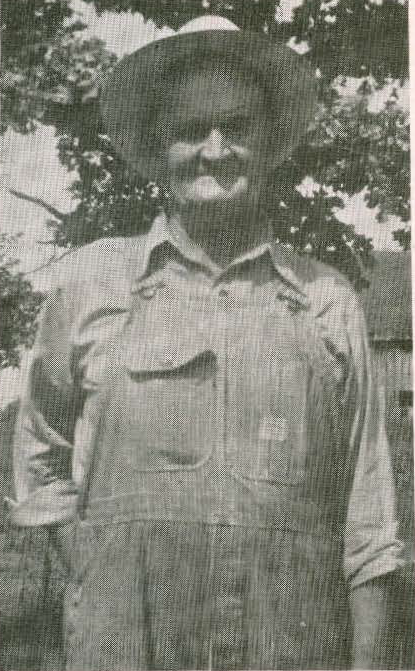
E.A. Knight of North Little Rock, recently in recalling his 36 years of experience in the dairy business. Mr. Knight recently sold his dairy herd.
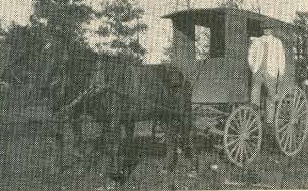
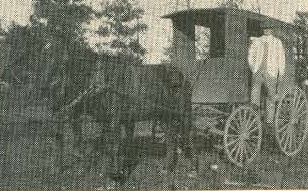
When asked to describe his early experiences, he seemed to forget the present world crisis, and go back in memory to the autumn of 1906, when he bought 17 milk cows, part of the James A. Henry herd, and paid what was then considered a “good” price, $18 a head. The milk wagon bearing the name “Oak Grove Dairy, Fresh Milk,” was “thrown in.” With the proprietor’s name changed to his own, Mr. Knight made his first milk delivery.
Older residents of North Little Rock well remember Turk, the sorrel horse and Jack or Ned, the little black one, who
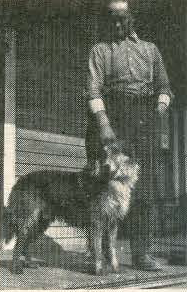
substituted when Turk lost a shoe or Jack had a balky spell. They will also remember Pippo, the shepherd pup who ran ahead of the horses.Milk bottles were unknown then: milk was carried in large cans, each containing a long-handled dipper with the measurements marked on it.
As the driver began his route, the reins were dropped, the horses knowing the route as well as the driver. Sometimes the distance of four or five blocks were covered without skipping a house. Traffic laws were unheard of. The clanging bell on the wagon brought the sleepy housewife hurrying out with a pitcher, bowl, or any vessel that could be snatched
hurriedly. Since few kept ice, the milkman must make the rounds in time for breakfast. Often a door would be partly opened with a bare arm extended holding out a pitcher. He would hear a sleepy voice say, “Please, Mr. Knight,
bring me one quart. I’m not dressed yet.”
To save time in making delivery, tickets were sold at 1O for $ 1.00, with an extra one if paid in advance. For wholesale
customers, hotels, restaurants, drug stores, milk was left in cans containing the needed amounts.
In July, 1908, Ernest Knight and Clara B. Wright of Little Rock, were married. After living for one and a half years north of town, he bought the Tom Baldwin home at Seventeenth and Magnolia streets, and moved the dairy to a 10-acre tract nearby, making this his home for fourteen years. During this time an electric milking machine and cream separator were bought and put into operation, and the wagon and team were replaced by a delivery truck. With these new conveniences, delivery was made only once a day.
In the summer of 1914 the Gazette carried the following story:
“THEY MOURN FOR PIPPO,THOUGH HE WAS BUT A DOG.”
“The death of a dog is not a stirring incident in the life of a community, and we are wont to think of such an occurrence as just ‘one less dog and one less license,’ and that’s all there is to it, but residents of Argenta who have known Pippo, the kindly affectionate and shaggy old Pippo, who for nine years followed the milk wagon of E.A. Knight, winter and
summer, who always greeted them with a soft smile, as it were, and a kindly wag of his tail, will be grieved to know that he has passed away.
“Pippo was sort of silent partner in the dairy business with Mr. Knight , and his patrons were as much pleased to greet
Pippo every morning as they were the bottle of milk, as Pippo was a sociable sort of fellow who loved to meet everybody and a fellow that everybody loved to meet. He started in the dairy business almost at the same time as
Mr. Knight, and has always been right on the job.
“He began his career when about one year old, and residents of Argenta who were at that time patrons of Mr. Knight, can remember his halycon days, when he used to run and leap and bark, after the wagon and impart the very joy of living into the staid and conventional human race.
“Gradually he grew old. not old as mere men define the term, but old for a dog. As youth departed Pippo grew more conservative and began t0 take life seriously. His joyous leap lost its elasticity and instead of running in front
of the horses barking and leaping, Pippo took a position in the rear of the wagon and trudged along faithfully at his task.
“Pippo wasn’t the sort of a fellow to, complain. He didn’t watch the clock for quitting time. He stayed right on the job until the work was done and then slept under the wagon to he sure he would not be late for work in the morning. As years rolled by and sapped his youthful vitality, and when it became a trial for him to follow in the tracks of the
horse over miles and miles of Argenta streets, he never complained. His life of activity made it impossible for him to stay home resting on laurels won in the past.
That same activity, that same attention to business and faithfulness that kept him trudging beside his master, made
Pippo ill. He laid off for a day and Mr. Knight had a vetinerary surgeon to attend him. Next day he tried to follow the wagon but the intense heat was too much and in the presence of Mr. Knight and the surgeon who had exerted every effort to prolong Pippo’s life, he died and was buried, but will never be forgotten by friends who can be counted by the score.”
For many years Argenta was a part of the city of Little Rock, but the growth of the town, coupled with the public
spirit of her leading citizens led to separation of the two cities.
When this was accomplished, Argenta took on new life, Mr. Knight has seen streets and sidewalks that were barely on equality with country roads, well paved, and three of the most important streets spanned with viaducts.
Street cars were added; churches and schools took on new life, and the Fire and Police departments greatly improved.
The railroad shops, factories, mills and compresses with large payrolls, helped to make North Little Rock one of the most rapidly developing cities of the country.
With the growth of the city, the milkman’s troubles grew also, milk inspectors who made regular visits to dairy farms became a necessity; better equipment was demansws, including covered milk pails, bottle filler and capper. All the milk sold had to be bottled. Then as now, very few Arkansas pastures were free from a growth of wild onions which add to the dairy-man’s worries. When the weed was eaten by the cows it ruined not only sweet milk, but the buttermilk and butter as well. When wild onions were gone up sprouted the bitter weed. This made both sweet and buttermilk bitter, but did not affect the butter. Through the hot summer days the fly sprayer and swatter were kept in constant use for bossy must be protected from the pests to increase milk production.
“Cows, like people, form habits,” said Mr. Knight. When the barn door is opened Old Lightning was first to rush in, followed by Daisy, Devil, haywire and Bess, each taking her place lile hungry boys at the dinner table. Whatever their method of counting, the exact number was waiting in line morning and afternoon.”
During World War I the price of milk soared to 21 cents per quart, and butter reached 72 cents a pound. There were times when help was hard to get or keep since the younger men were being drafted into the service. Amoung those who came and went were an ex-carnival man, a young man with a peg leg, a one-armed man, a Negro boy called Sunshine, a retired engineer, a meat cutter, head bookkeeper for a wholesale grocery, a boy direct from a French colony in Switzerland, who could speak only one word of Engligh: “finish.”
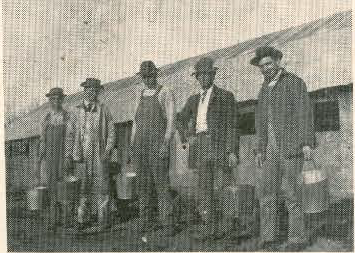
Some stayed on an worked for four or five years, but the average dairy hand came because he was down and out and hungry. When his belt began to tighten and the snow began to melt away, with the coming of spring, he would wander down the road.
In September, 1922, with a larger herd, more pasture was needed as a large farm on the river east of Little Rock was bought. This was an ideal location and all went well until along came “Old man River” with the flood of 1927, and with the caving of the land, the buildings, including the dair barn, milkhouse, tenat houses and large horse barn were all destroyed.
The dairy cattle were moved out hurridley on Sunday morning to a pasture and temporary bar, which was part of the pcric acid plant, used during WWI. The family followed later. Here in the summer of 1931, the barn and all dairy equipment was destroyed by fire.
Mr. Knight took a new start. A lease was obtained on the Dortch farm near Willow Beach, the only dairy farm available. Here he carried on the business for one and a half years. Three daughters were of little use in milking and feeding cows, or raising calves, but his son learned to milk, helped with the work in the milkhouse and became a real dairy hand.
No less faithful, however, was Mrs. Knight, who was called upon when a dairy hand was sick, or they were late in getting ready for the delivery. Churning, moulding and wrapping the butter was her job, which was no small talk, since she made 60 pounds a week.
When the farm was sold he moved to his present home on the Conway pike. The four children of Mr. and Mrs. Knight are: Helen, nor Mrs. L.G. Howden, who is with her husband, Lieutenant Howden, stationed at Camp Edwards, near Boston; Alice, now Mrs. E.J. Bush, employed in the Navy Department in Washington, D.C., whose husband is stationed at Scott Field, Illinois, where he is a member of the Air Force; Roy, a graduate of North Little Rock High School, now attending Little Rock Junior College and a member of the Navy Reserves; and Evelyn, a senior at North Little Rock High School.
When asked for his formula for successful living, Mr. Knight gave the following: “If people as a whole could free themselves of selfishness and greed and work for the interest of all instead of the interest of a few, this could be a better world.”
About his plans for the future, now that he is no longer a dairyman, Mr. Knight has little to say except, “I still have some fine heifers in the pasture; hobbies aren’t idle things, and you can follow them a long way, even into a job you’d rather do than anything else.”
May 30, 1943
Argenta Comes Alive
Mr. and Mrs. J.C. Carmack
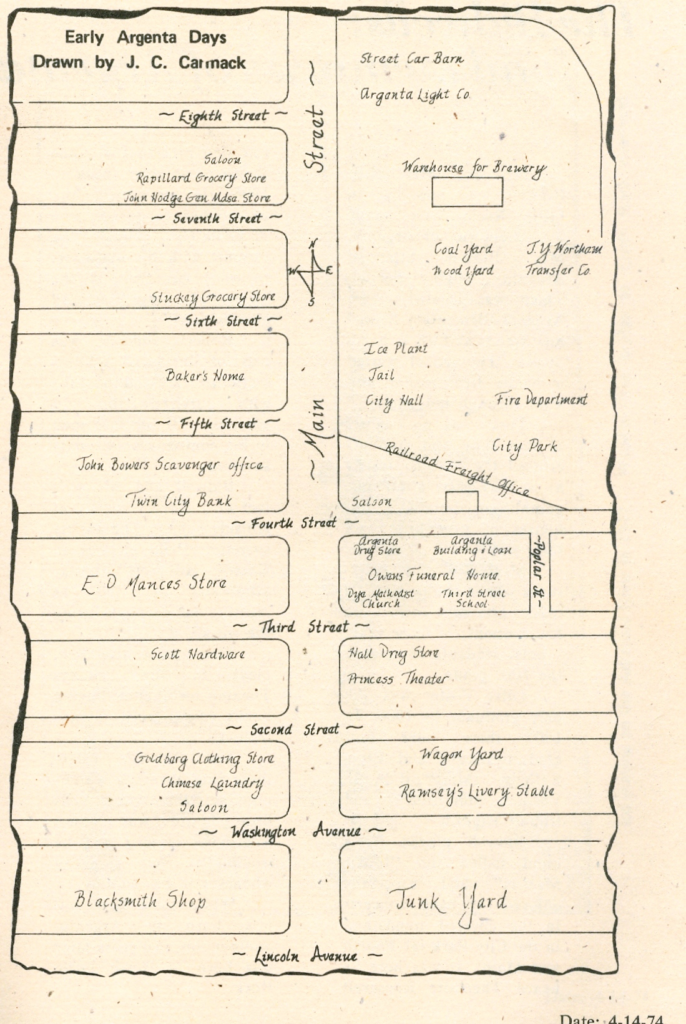
As you talk to those “who were there” Argenta comes alive. You see the families in their buggies crossing the wooden, free bridge. You hear the curfew bell ring promptly at 9:00 each evening. The riverboats go up and down the Arkansas River. There is a steady flow of traffic to and from the saloons and gambling houses. As a you start to school you see the prisoners from the city jail, secured by ball and chain, working on the muddy streets.
Such are the memories of J.C. Carmack, 1714 Maple Street. His parents were Charles Edward and Lydie Burns Carmack (a sister to the late Dr. William M. Burns). Their family lived on West 6th Street by the alley between Maple and Main Streets, close to the location of the present Goodyear store. His father worked as plate sewer for Temple Cottonseed Oil Company at the end of Maple Street between Eight Street and the railroad tracks.
Carmack attended Third Street School, a big frame building with a fence around it. It was loacted about where City Hall is, facing Third Street.
Argenta was a rough a prosperous city, Carmack recalls. “We had four railroads and people came from all parts of the state to our barrell houses (wine and liquor stores). Beer was served in bars, saloons and gambling houses. And the only people ever seen on the streets after the curfew bell had rung were those from out of town who frequented the saloons.”
There were no through streets to the east side of Main from Fourth to Ninth Streets and the only thoroughfare on the west side was down Lincoln Avenue around River Road by Vestals to Baring Cross. Main Street was developed as far as 22nd, with a few houses along the way.
Carmack remembers the sawmill on the river between Missouri Pacific Shops and Maple Streets. the logs floated down the river to the mill.
Argenta Light Company manufactured its own power to provide electricity for perhaps about 125 customers in the city and furnished power for a street car that ran downn Main Street. Most residents still used coal oil lamps and had no indoor plumbing. Carmack laughed as he and Mrs. Carmack explained that scavenger service was a crew in a steel wagon pulled by two horses that cleaned and sprayed out-houses for $1.00 a month. They always worked at night an you could hear and “smell” them coming. Men who drove these wagons wore a big carbide light on a band around their forehead.
Silent movies were shown at the Princess Theater and Carmack got in free for some of them. His older brother took up tickets and when he was sick the owners permitted J.C. to take his place.
He and his brothers and sisters looked forward to trips across the wooden river bridge. It was always referred to as the “free” bridge, since it cost a nickel to cross Baring Cross Bridge. “There was a $5.00 fine to trot your horse across the bridge and not many people ever violated that ruling since that would have been about a week’s wages,” he said.
Carmack’s mother bought one pound cans of Arbuckle coffee beans and ground and brewed her own coffee. She saved the coupons from the coffee cans for a sewing machine.
In 1907 the Carmack family moved from West Sixth Street to a farm on what was later platted as 26th Street.
Argenta Race Riot of 1906
AKA: Lynching of Homer G. Blackman
Encyclopedia of Arkansas History and Culture
Ignited by the slayings of two black men in separate incidents the previous month, racial animosity flared up in Argenta (now North Little Rock in Pulaski County) in early October 1906, leading to the violent deaths of three more men over four days, including the lynching of Homer G. Blackman (called in some reports Homer Blackwell), a black restaurateur. Local authorities imposed martial law and provided additional officers in an effort to quell hostilities. However, before order was restored, half a block of commercial buildings on East Washington Avenue burned down, two African-American residences went up in flames, and scores of black families temporarily left the city as armed men roamed the streets.
The two major newspapers in Little Rock, the Arkansas Gazette and the Arkansas Democrat, reported that the trouble stemmed from a barroom fight in which a white former Argenta policeman, Robert R. McDonald, killed a black musician, Wiley Shelby, on September 11, 1906. Coroner S. Paul Vaughter attempted to convene an inquest into Shelby’s death the next day at the black-owned Colum Brothers Funeral Home at 505 East Washington Avenue, but a melee interrupted the proceeding after Garrett Colum, who operated the funeral home with brothers Charles and Robert, attacked Milton Lindsey, a white Argenta patrolman, for blocking a group of black people from entering the premises. During the confusion, two shots rang out, and Robert Colum fell dead from gunshot wounds. A jury, appointed by Justice of the Peace Frank P. Vaugine, ruled on September 13, 1906, that Robert Colum “met his death at the hands of someone unknown,” the Democrat reported that afternoon. The newspaper noted elsewhere in the September 13 edition that the coroner’s jury heard testimony concerning Shelby’s death and found that McDonald had acted in self-defense.
On the evening of October 6, 1906, John B. Lindsey, a farmer, and Milton Lindsey, his son, were ambushed as they walked in front of the Colum establishment. The elder Lindsey died from eleven gunshot wounds, and the younger suffered injuries. Police officers who tried to enter the Colum business were met with gunfire, and some fifty or sixty armed white men gathered across the street. Argenta Mayor William C. Faucette, on advice from Police Chief Gabe Pratt and Pulaski County Sheriff Coburn C. Kavanaugh, closed the saloons to forestall a riot. Faucette also ordered a ban on carrying firearms, except for sworn officers, and prohibited anyone from making inflammatory public statements. Charged with murder in Lindsey’s death were Garrett and Charles Colum, along with Louis Styles, a black shoe store owner two doors down from the Colums, but the three men had escaped by the time Faucette and a posse of fifty men stormed the Colum’s building. The posse then went to Charles Colum’s home at 1517 East Second Street, where someone fired a shot at one of his sons.
Overnight, fires engulfed Garrett Colum’s home at 1600 East 2nd Street and Styles’s house at 522 Locust Street. An African-American eyewitness told the Democrat that members of the mob tried to force the women and children back into Colum’s house after it was set afire, “but that later cooler heads came into control” and allowed them to flee. The paper quoted a newspaperman on the scene who said he heard about the incident but did not see it because he was on the other side of the house. Meanwhile, on East Washington, fire destroyed four buildings, including several businesses, both black- and white-owned, in the early morning hours of October 7. Rumors ran wild for the next few days, and fears of arson in Argenta’s black-populated east end convinced many to leave until calm was fully restored several days later. Scipio A. Jones, an African-American civil rights lawyer, arranged shelter in Little Rock (Pulaski County) for the Colum families. Many others stayed, among them women and children who gathered for protection at Shorter College and at the Hillside school in the black community of Military Heights. With a force of some twenty additional officers, the police guarded these places and posted men to ensure the safety of black workers at the railroad yards, cotton oil mills, and compress factories.
Homer G. Blackman, who shared an East Washington building with Styles, was arrested on October 7, 1906, for allegedly firing at the Lindseys. That evening, four masked men seized Blackman from the Argenta city jail and marched him, as others watched, to the corner at Sixth and Main streets, where they hanged him from a utility pole and shot him multiple times. A coroner’s jury concluded that Blackman died “at the hands of parties unknown,” the Democrat reported the next day. The Gazette maintained that Blackman was innocent of the charge because he did not arrive back by train from Lake Village (Chicot County) in time to have been in Argenta when the Lindseys drew fire. However, according to the Democrat on October 9, 1906, a witness reported seeing Blackman run from his restaurant two doors down from the Colums’ building with a pistol in hand immediately after shots were fired at the Lindseys.
On October 9, 1906, Alex Champion, a black bartender, was shot and killed in the Bridge Saloon at the foot of the free bridge for allegedly making threats against Luther Lindsey, a deputy sheriff and a son of John B. Lindsey. A murder charge against Luther Lindsey in connection with Champion’s death was dismissed.
The historical record is sketchy as to what happened to the fugitives. Last word in the newspapers was that the three remained as fugitives and had possibly escaped to Indian Territory in Oklahoma. The events of September and October in 1906, while sending a hateful reminder of African Americans’ second-class legal standing, did not slow the economic and social progress of Argenta’s black citizenry.
Cary Bradburn
North Little Rock History Commission
The Disapperance of Dwight M. Pixley
Of North Little Rock’s elected mayors since 1904, only Dwight M. Pixley has no portrait hanging in City Hall.
Why no portrait?
What’s known is that Pixley, who served one term from 1917 to 1919, was arch enemy of the powerful and influential James P. Faucette, mayor from 1911 to 1917.
Faucette blamed Pixley for the city’s debt, though the city was in debt when Pixley, a dentist, succeeded Faucette in April 1917. Faucette incurred the debt in 1914-15 to construct and furnish City Hall for $84,000.
Few photographs are known to exist of Pixley. North Little Rock photographer Thomas J. Echols took one of him in his dentist office in the new Matthews Building in 1910. Newspapers carried mug shots of him.
The North Little Rock Times reported November 23, 1927, that the city would hang “life-sized pictures” in City Hall of former Mayors William C. Faucette (1904-09, 1910-11), James P. Faucette, Pixley, William Burns (1919-21, 1925-27) and George Scott (1923-25), as well as Ross Lawhon, who was the current mayor at the time.
That was done, except for Pixley.
He was a fugitive.
Pixley is the only mayor in the city’s history to stand trial for a felony. In December 1918, he and his assistant Paul Grabiel were acquitted by a circuit court jury of burning down a building at Second and Main.
It took four minutes to reach a verdict.
Two days before Pixley left office in April 1919, someone fired two gunshots and a bullet passed through his hat as he was driving into his garage at 311 Poplar Street, according to an Arkansas Gazette reporter, who was with him.
In June 1919, reports circulated that a grand jury was investigating Pixley in connection with missing funds from an improvement district.
He didn’t stick around before being indicted in 1920.
Fleeing Arkansas, he first went to Illinois, his home state, and then to Alabama, where law enforcement tracked him down and arrested him in 1920 for grand larceny and embezzlement.
Pixley fought extradition and lost.
Then he disappeared – again.
His whereabouts remained a mystery until he died in Miami in 1956, according to an obituary.
–Cary Bradburn