

Early Public Schools
Schools have been a part of community life in America since colonial times. Land surveys in the 1800s set aside a portion of each section for a school house. Although private and church schools existed as early as the 1820s in Arkansas, there were no public schools until the 1860s.
In 1868 and 1874, the Arkansas Constitution mandated a free public education for everyone, ages 5 to 21, regardless of race. The practical result was the creation of segregated schools under the authority of local school districts.
Universal education, however, was still theoretical for many. By 1870 only about half of the eligible Black children and 60 percent of whites were enrolled in Arkansas public schools. At that time, Argenta had no public schools, though that would change before the decade was out.
The earliest schools on the north side were part of a rural school district that stretched from Argenta and Baring Cross to Oak Grove. By the mid-1880s, Argenta schools were aligned with Common School District No. 16 of Little Rock, according to a school history by the North Little Rock Times in 1936. The article said an Argenta school board set policy, but was not financially independent. Two Black men served on the board.
Evidence of the first white school in the north side district appeared in the 1878 city directory, listed as Argenta Public School. No address was given. There also may have been a Black school about this time, given the constitutional mandate and Black representation on the board. However, city directories did not list an Argenta Colored School until 1887.
The first known wood frame school house in Argenta was on the northeast corner of what is now West Fourth and Orange streets. It opened in 1884. A photograph of a twostory building, known as the Fourth Street school, was published in a souvenir program for the dedication of Argenta High School in 1913.
Fourth Street School became a Black school from 1888 to 1895, after construction of Argenta’s first brick school house school for white students in 1888. Now the present site of the Elks Lodge at Poplar and East Broadway, the school featured a grand central tower. It was first known as the Argenta Public School, then the Jefferson Street School, and later the Third Street School, as identified in the 1913 souvenir program.
This souvenir program also had a photograph of the Hillside School, a one-room frame schoolhouse built in 1882 at 700 West 29th in Military Heights. According to a North Little Rock School District “ledger” now archived at the city’s History Commission, the Hillside school was located “near the families [indecipherable] wagon roads.”
North Little Rock historian Evelyn Eubank said that students from German, Swedish, and Italian families attended Hillside School. “Some were children from Iron Mountain (Railroad) shop works, some from Fort roots army camp, and one little girl an English orphan.”
“The few children on Rawls Hill (Scenic Hill) attended either the Hillside or the Oak Grove schools,” Walter Metz wrote in the North Little Rock Times in 1978. “Folks did not mind walking in those days. I walked a mile (to the Baring Cross School); other children walked two miles or more to the Oak Grove School.”
The Hillside School name “came naturally,” Eubank wrote. “It was located on a gradual slope that led from Moore’s Hill (Cherry Hill) to the Railroad Avenue track.” There were separate playgrounds for boys and girls. Both had outdoor toilets in outhouses.
The district’s ledger and Corrine Messenger, longtime secretary for the North Little Rock School Board, wrote that Hillside became a Black school in 1904. Both accounts said that Black students transferred to the Hillside School from the one-room Schaer’s Addition School, which they also identified as the Military Heights School. White students, who had been at Hillside, paid tuition in 1905 and 1906 to attend the Oak Grove School, until a new school opened in Levy in 1907.
Messenger located the Schaer’s Addition Colored School “probably about 18th and Pike.” However, better evidence comes from the district’s ledger, which located the school on lots 1-3 in Block 5 on the southeast corner of 21st and Schaer. The property was sold years later to the North Little Rock Housing Authority for development of Silver City Courts.
Almost nothing is known of a Jackson Park School, listed only in the 1898 city directory as a Black school at 2023 Maple Street. These students possibly enrolled at Schaer’s School after Jackson Park closed. But could Jackson Park and Schaer’s have been the same school at some point in time? Why would there have been two Black schools just a few blocks apart? One reason could be that the schools were on opposite sides of the busy Iron Mountain Railroad tracks. It is not known how long the Jackson Park School existed, or if it was even open more than a year.
Known as “The Little Red School House,” the Schaer’s or Military Heights Colored School, operated from about 1880 to 1904. G.H. and Malinda Ripley, both Black teachers who were quoted in the ledger, said Schaer’s School had one teacher for grades 1-5. After fifth grade, Black children attended “The School under the hill” located “right on the (Arkansas) river” between the Baring Cross Bridge and the free bridge (later the Main Street Bridge), the Ripleys said.
This five-room school “under the hill” went through the eighth grade, the Ripleys said. Most likely they were talking about the Argenta Colored School that moved from Argenta in 1895. The location was at Second and Gum streets in the West End, an early Black community near the Iron Mountain rail yard. Wood mills dominated along the river bank. The Ripleys mentioned Wilson Stave Mill as being near the school.
A description of the Argenta Colored School was given in a letter in the early 1900s from Charles W. Rawlings, principal in Argenta from 1892 to 1897, to William C. Faucette. Rawlings said the school was housed in a “primitive” five-room building on Second Street, with 175 to 200 pupils. Most of the older children were girls because the boys dropped out to work in the railroad shops and mills, he said.
Clendenin Hill School in the 500 block of West 14th Street existed by 1890, according to city directories. There is conflicting information over whether the address was 515 or 521 West 14th. The directory mentions no exact address. Evidence suggests there was an earlier one-room Clendenin Hill School and a later two-room school.
Walter Havens of the Clendenin area provided a hand-drawn map of the two schools. He placed the one-room frame structure in the middle of the west half-block between Gum Street and the alley on West 14th. He also shows the newer two-room school near
the curb at 515 West 14th.
Corrine Messenger’s history of the Clendenin Elementary School, 1902-1950 reported that the Clendenin Hill School was at 521 West 14th on lots 4, 5, and 6 in Block 40 of the North Argenta Addition. The source of her information was Lizzie Claire Speer of the Arkansas History Commission.
“Mrs. Speer spoke of the great amount of water, swamps, and cypress trees, and the beauty . . . She told of a lake that ran from Main Street to Pike Avenue, and from 12th to 14th streets. She said the (Iron Mountain) railroad bed had been built up out of this lake, and that the property at 521 West 14th was on a bluff overlooking this area,” Messenger wrote.
In September 1901, residents organized the North Little Rock Special School District. Unlike the old Common School District No. 16, it was Independent of Little Rock and had authority to raise a millage tax. The first order of business was to purchase property on the northwest corner of 13th and Main and build a four-story brick building, with an impressive tower. The school, named Northside High School, opened in 1903 for grades 1-11.
For decades the school building was called Clendenin Elementary School. A new school building replaced the original in 1950. It too was razed in 2023 and is now the site of the North Little Rock Fire Department’s central station. When the original building opened in 1903, heating was by a coal stove and outhouses served as bathroom facilities.
The North Little Rock School District opened four elementary schools from 1906 to 1909: Riverside at 1417 Arkansas Avenue in 1906, Levy at 37th and Clinton Pike (later Camp Robinson Road) in 1907, East End for Black students at Second and Redwood in 1907, and Baring Cross at 10th and Parker in 1909. Baring Cross, which ran its own school district until 1905, had operated a school since 1894. In 1909, the Argenta Colored School moved from the West End to Ninth and Hickory streets in the Shorter College area. A high school curriculum was added in 1911, in addition to elementary and junior high grades. The name was changed to the Hickory Street School (later known as S.A. Jones).
Argenta High School opened in 1912. Housed in a three-story brick building (later four stories) at Fourth and Willow streets, it was designed by noted architect Charles L. Thompson. The older Northside High School at 13th and Main, which had been renamed Argenta High School in 1905, became Clendenin Elementary.
Before establishment of the North Little Rock School District in 1901, enrollment numbers for north side schools aren’t available. An exception is Rawlings’ letter that said 175 to 200 students attended the Argenta Colored School. Summaries of School Board Minutes from the district’s files show total enrollments of 537 in 1904, 657 in 1905, 1,298 in 1906, and 1,259 in 1907.
Messenger provided enrollments for the 1912-13 school year, based on School Board Minutes. Her figures show an overall district enrollment of 2,136 in 1912-13, including 1,411 white students and 725 Black students. Argenta High School had 600 pupils. The numbers for 1913-14 were incomplete.
None of the city’s early school buildings exist today.
–Cary Bradburn
History of North Little Rock Public Schools
OVERVIEW: TRENDS IN EDUCATION
Since the 1870s classrooms have changed from chalk boards to smart boards, from paper notebooks to computer tablets, from lectures to interactive instruction, from strictly books to video. Due to the COVID-19 pandemic of 2020 and its aftermath, the classroom itself moved online. Both in-person and virtual school is the norm.
Argenta’s earliest schools were small frame buildings. The first brick school at East Broadway and Poplar in 1888 featured a central tower, which became the design of a larger brick building in 1903 for the city’s first high school at 13th and Main.
The style for elementary school buildings through the 1920s was red brick. But a departure in 1929 created a grand three-story Art Deco-style building for North
Little Rock High School at 22nd and Main that stands today.
In 2015, a new North Little Rock High School of four multistory learning towers ushered in the future. A modular style with atriums and learning stairs supports
an emphasis on science, technology and arts.
EARLY PUBLIC SCHOOLS
By 1878, Argenta’s public schools had organized into separate schools for white and Black students. Public and parochial schools in North Little Rock remained
racially segregated until 1964.
The first school district in Argenta was controlled by the Little Rock School District, which afforded little funding for north side schools. Residents in 1901 formed the North Little Rock Special School District, an independent system with authority to raise property taxes.
This enabled the district to build Northside High School in 1903 at 13th and Main. The four-story brick building and tower, known through most of its history as
Clendenin Elementary School, survived until a new building replaced it in 1950. That building was demolished in 2023 to make way for a new central fire station.
Black students in 1909 began attending a new school at Ninth (now S.A. Jones) and Hickory that included primary and secondary level curricula in a three-story
brick building. A high school program was added in 1911.
By request, the school district named the primary and secondary school as Hickory Street School in 1911 and renamed it in 1928 to honor Scipio A. Jones, a
benefactor and noted attorney. The school district built a new S.A. Jones Junior- Senior High in 1952 at 901 East 10th.
Argenta Senior and Junior High School, constructed in 1912 as three stories and rebuilt to four stories after a fire in 1925, stood at Fourth and Willow. It became
solely a junior high school in 1929 after the district built the Art Deco-style North Little Rock High School at 22nd and Main.
The public school district operated elementary schools throughout the city beginning in the early 1900s. These included Clendenin, Riverside, Baring Cross,
Levy, Park Hill, Woodrow Wilson, and Rose City.
NEW SCHOOLS
The influx of baby boomers caused higher enrollments that forced the School District to build new schools and add trailers for more classroom space. Fourth
Street and Jones were the city’s only public junior high schools until the district opened Jefferson Davis in 1953 and Ridgeroad in 1958.
The district built new elementary schools in the 1950s and 1960s in Lakewood, Pike View, Indian Hills, Levy, Amboy, Rose City, Glenview, Meadow Park, and
Sherman Park.
Northeast High School at 2400 Lakeview, Lakewood Junior High at 2300 Lakeview, and Rose City Junior High at 5500 Lynch Drive opened in 1969 as desegregated schools.
S.A. Jones Junior-Senior High closed in 1970 and reopened the next year as Central Junior High seventh grade school. Northeast High’s first graduating class
received diplomas in 1971. With students attending the city’s two high schools, the district renamed North Little Rock High as Ole Main in 1972.
MIDDLE SCHOOLS, HIGH SCHOOL MERGER
In 1990, the city’s public schools initiated a middle school system. In addition, Northeast and Ole Main merged as North Little Rock High School, with grades 9
and 10 at East Campus (formerly Northeast) and grades 11 and 12 at West Campus.
Voters approved a 7.4-mill property tax in 2012, allowing the school district to undertake a $265 million construction and renovation program that reduced the
number of schools from 21 to 13. The surviving schools were built new or extensively remodeled.
The new North Little Rock High School serves grades 9-12. Lakewood Middle School and the East Campus were reorganized as North Little Rock Middle School for grades 6-8.
Charter Schools
The state has approved four open enrollment charter public schools in recent years in North Little Rock.
Premier High School offers a non-traditional approach focused on students at 801 West 29th Street.
Friendship Aspire Academy has a North Little Rock campus for grades K-5 at the former Bellwood school at 3901 Virginia Drive.
LISA Academy has a K-5 program at 5410 Landers Road and a middle-high school at 1 Lisa Academy Way off Landers, adjacent to its elementary school.
The North Little Rock School District’s charter school Center for Excellence, in conjunction with the Little Rock Regional Chamber of Commerce, offers careerthemed academies that combine traditional academics with engineering technology, computer science, and health sciences. North Little Rock High School
also provides career academies in a variety of fields from business to the arts and health services.
Private Schools
Alternatives to traditional public education include home-schooling, private schools, and charter public schools.
St. Patrick Catholic Church opened a private school in 1895 in a frame building on Seventh Street (Bishop Lindsey today) between Olive and Cypress. St. Patrick Church and the school moved to brick buildings at 19th and Maple in 1931. Additional Catholic schools were St. Mary’s in 1897 at 16th and Parker in Baring Cross, now operated as North Little Rock Catholic Academy, St. Augustine’s for Black students in 1929 at Second and Clark, which has closed, and Immaculate Conception at 7000 JFK.
Several private schools opened in the late 1960s and 1970s in Pulaski County. Central Arkansas Christian School, founded in 1971 as an affiliate of the Churches of Christ, was originally located in Sylvan Hills and included grades 1-6. It added grades 7 and 8 in 1972 and 1973.
The next year, CAC opened a junior-senior high in Jacksonville and admitted, Black students for the first time. In 1977, the first class of nine students graduated. CAC relocated in 1978 to what it calls Mustang Mountain at Windsong Drive on I-430 in North Little Rock.
CAC has three campuses, with a total enrollment in 2023 of 816 from pre-school to grade 12: Mustang Mountain, North Little Rock Elementary at 6101 JFK, and Pleasant Valley Elementary in Little Rock.
Northside Academy with about 70 students was open from 1969 to 1972. Edgewood Academy at 900 Mission Road opened with a white enrollment in 1971
and closed in 1979. Other private schools have included Northshore Academy, North Little Rock Montessori, Central Arkansas Montessori, and several churchbased schools.
Central Arkansas Montessori at 900 Mission Road had an enrollment of 72 from pre-school to grade 6 in 2023. Calvary Academy operates two campuses at 1401 Calvary Road and 4500 North Hills with total enrollment of 415 for grades K-12 in 2023.
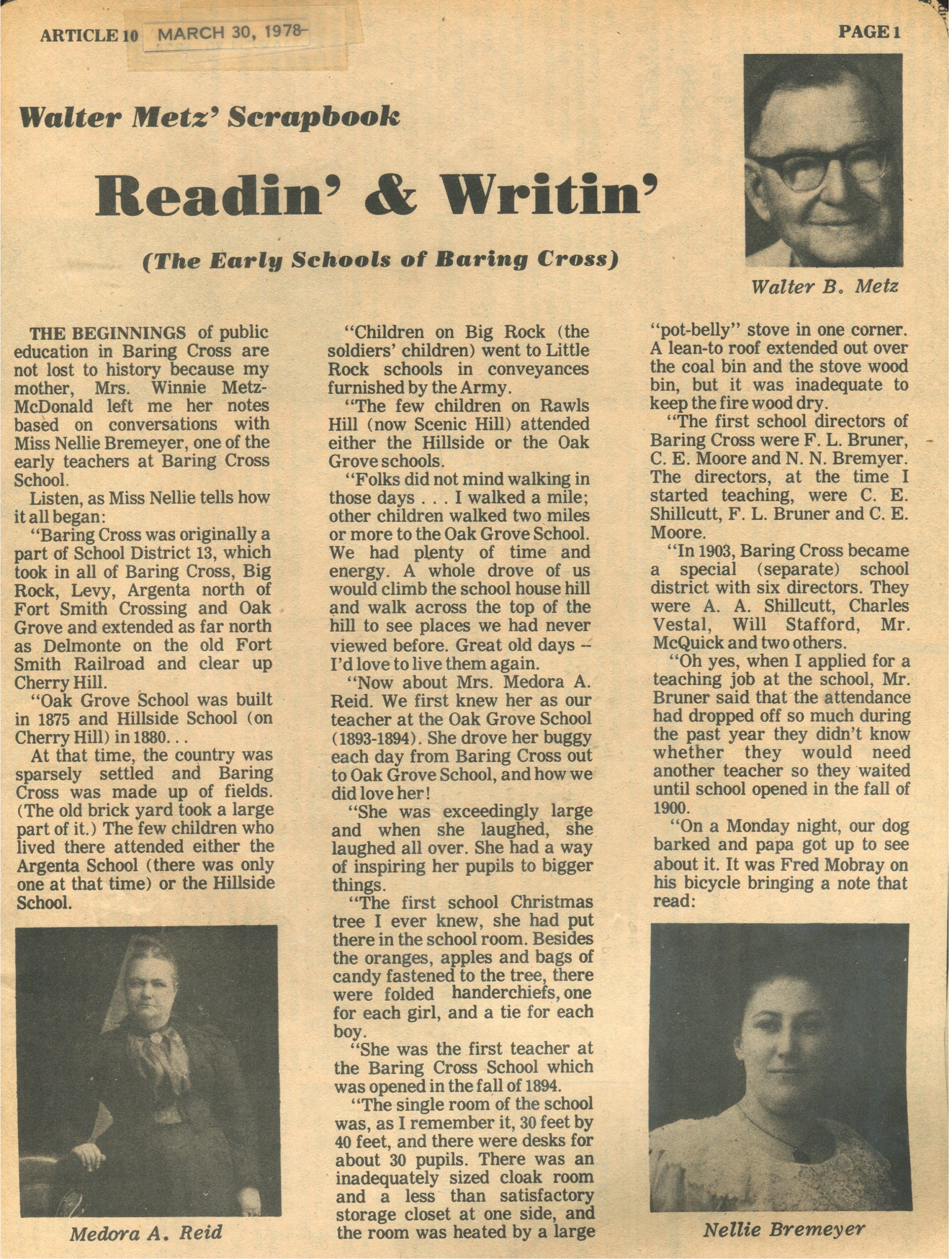
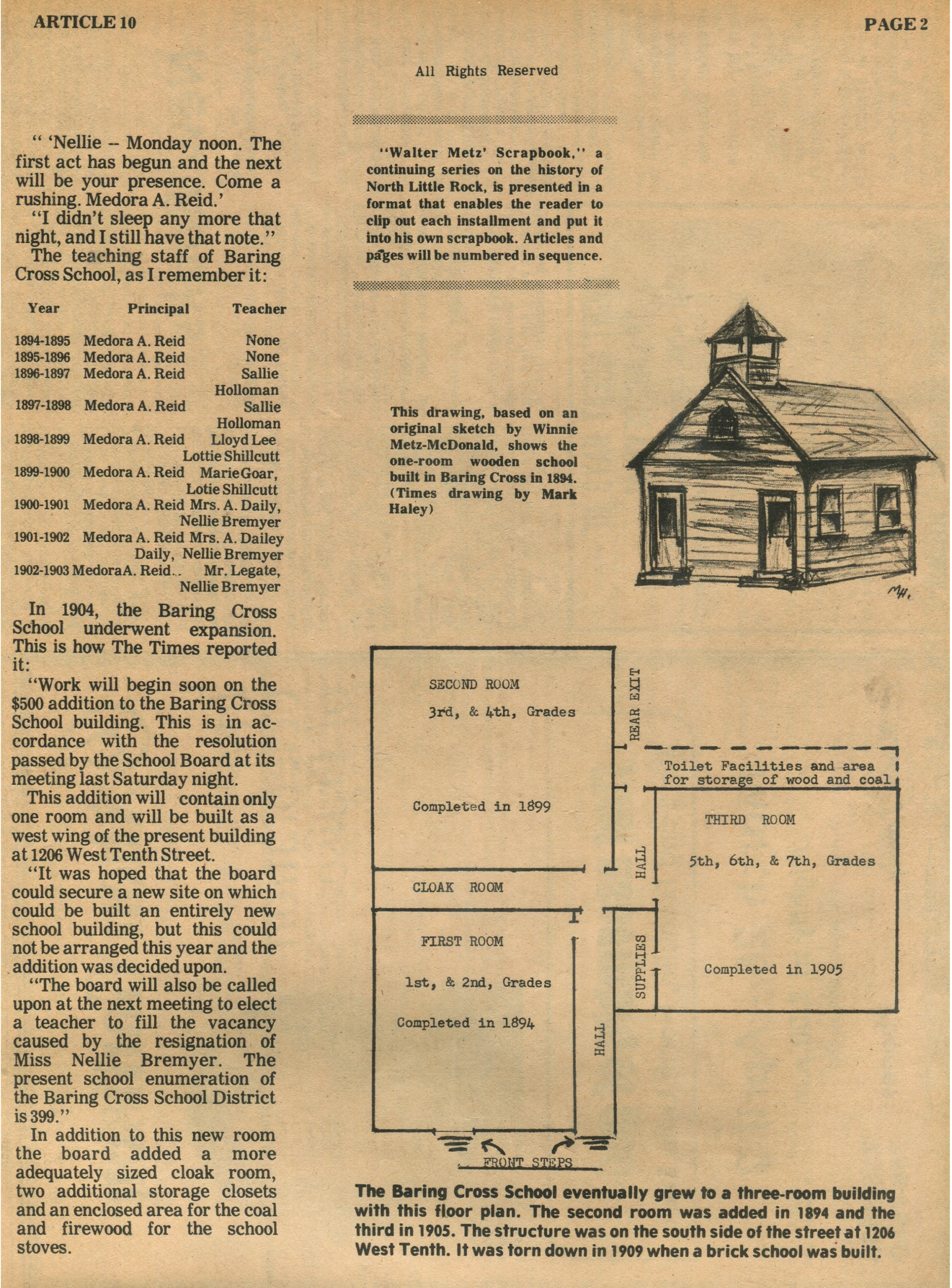
Readin’ and Writin’
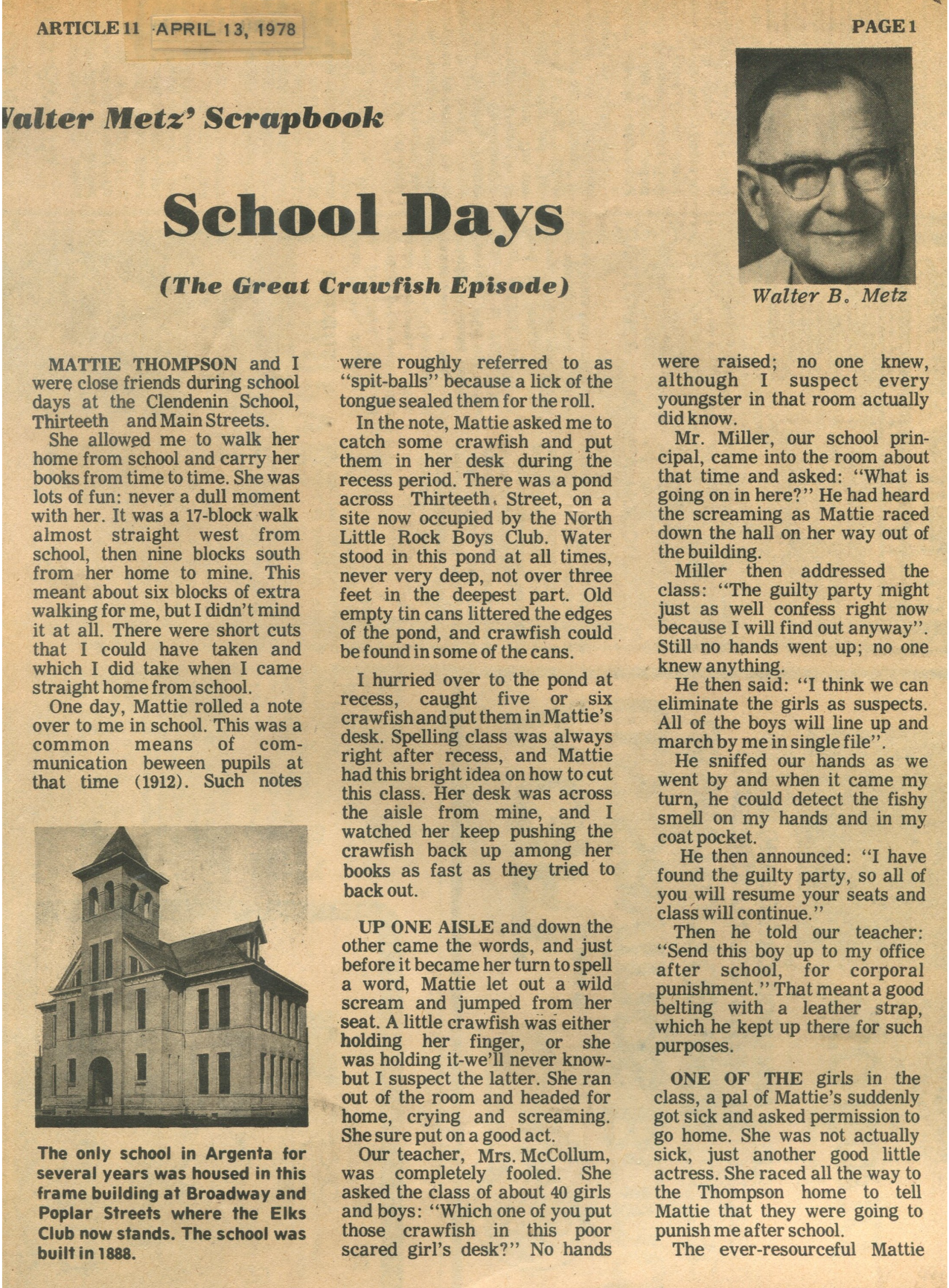
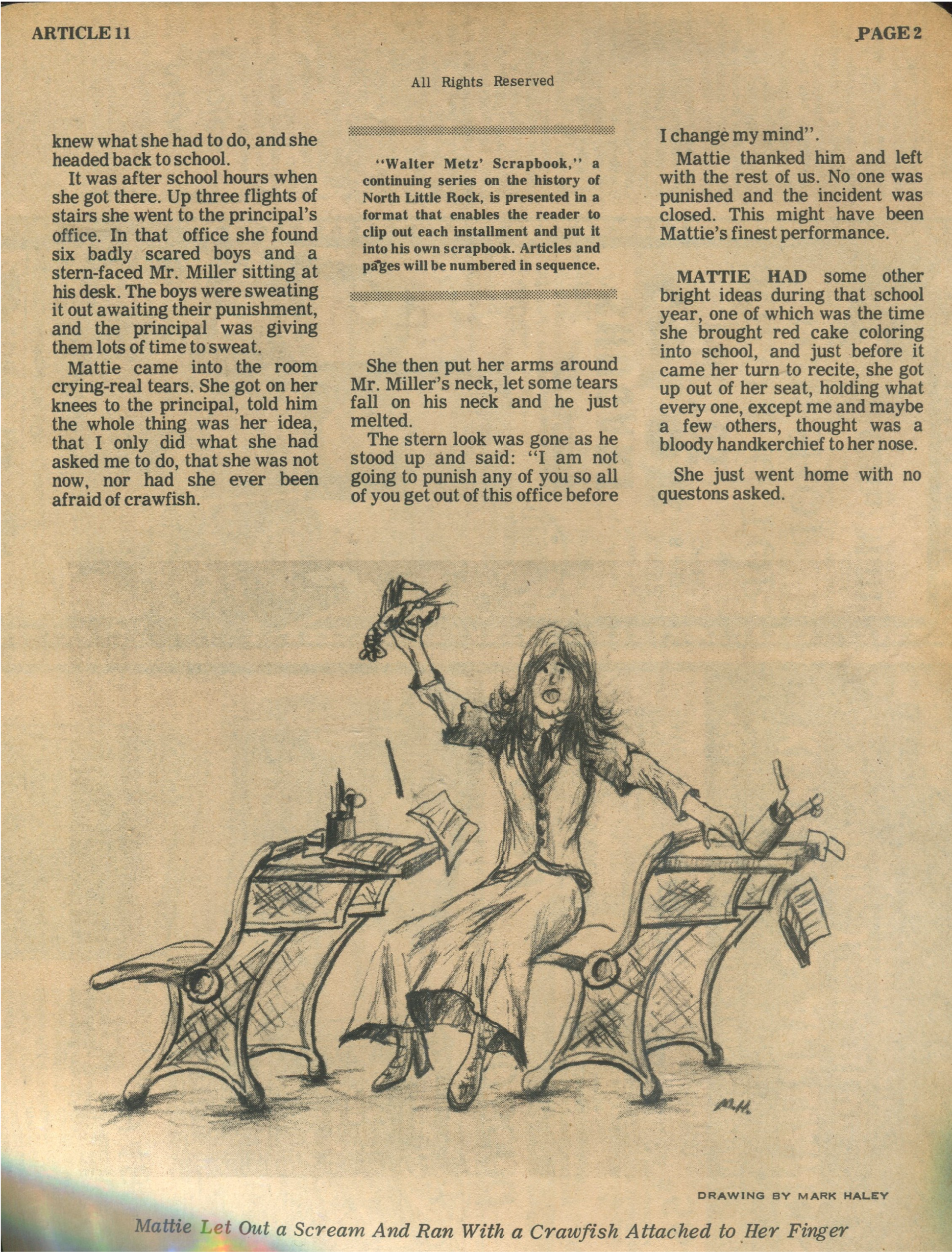
School Days
Higher Education
North Little Rock is home to two colleges with two-year associate degree programs: Shorter College at Sixth and Locust and the University of Arkansas Pulaski Technical College at Pershing.
Shorter College of the AME Church moved to Argenta in 1896 and built a threestory brick building in 1903, known as Tyree Hall, which accommodated
classrooms, offices, a library, and boys’ dormitories.
A four-year college until 1955, Shorter has a thriving, modern campus and a growing enrollment through affiliation with the University of Arkansas at Pine
Bluff. Among its graduates are Scipio A. Jones, a noted attorney, and Daisy Bates, a civil rights champion and supporter of the 1957 integration of Little Rock Central High School.
Pulaski Tech, once known as Little Rock Vo-Tech, built its campus on Big Rock Mountain in 1976. The school has realized tremendous growth in its physical
campus, student enrollment, and class offerings. It became a part of the University of Arkansas system in 2016.
Pulaski Tech
Origins and Early Years: 1917-1945
The history of vocational education in central Arkansas can be traced back to times of war and turmoil. When the United States entered World War I in 1917, the
Little Rock School District sponsored an adult vocational training program. This program grew during the prosperous decade of the 1920s. Enrollment in vocational training increased, as did the number of programs offered. The Great Depression of the 1930s saw a decline in enrollment as Arkansas’ population dwindled because thousands of people left the state in search of employment opportunities. Monetary support for the adult education program in Little Rock diminished as well, but was actually able to weather the financial draught better than anticipated. Fiscal problems were less acute due largely to the fact that the level of funding for Little Rock had grown during this time, with the State Board of Education shouldering most of the direct costs.1
The early 1940s brought promise as the economic depression began to wane, and in 1941 the state attempted to provide vocational and technical training on an institutional basis. In early 1941 the Arkansas General Assembly approved Act 261, which appropriated $50,000 in state funds for the construction, equipping, maintaining, and operation of a state trade school. This trade school would be under the control of the State Board of Vocational Education. A subsequent Act 295 passed in March 1941 provided that the State Trade School would offer instruction and training in trade and industrial subjects of less than the college grade; that the State Board for Vocational Education would control the school; and that the State Supervisor of Trade and Industrial Education would serve as Executive Director of the school, having the authority to appoint and remove personnel, and apply an architect with the eventual goal of constructing a facility.2 Act 295 originally called for the Trade School facility to be located on property occupied by the Arkansas State School for the Blind. This property
was located at 18th and Center Streets, which is currently the Governor’s Mansion. Residents in this area petitioned to stop the Trade School and it was never constructed here.
The Board of Vocational Education was granted permission to find an alternate site and a number of locations were considered including Conway, Malvern, Little Rock and North Little Rock. In the interim, a facility was rented at 601 West Markham in Little Rock. Training at this location was funded by the Wartime Production Training Act of 1940, even though at this particular time the United States was not officially at war. On December 7, 1941, the Japanese attacked U.S. military basis at Pearl Harbor and across the Pacific. These attacks formally launched the United States into World War II and, as a massive mobilization effort began across the nation, vocational training in Arkansas took on a whole new sense of urgency. The nation geared up for war and the Arkansas Trade School provided a great deal of support to the country’s war effort.
J.C. Ruppert, who served as the director of programs from 1941 until 1943, resigned when he entered the U.S. Navy. Ruppert was replaced by Fred Graham as the Trade School’s director. Thousands participated in the Arkansas State Trade School as the war was waged from 1941 to 1945. Programs offered training in occupations for shipyard, aircraft, electronics, and ordnance. Specific courses could be taken in welding, sheet metal, woodworking, machine tool operation, and drafting. These programs were generally funded with federal monies available for national defense and war production. No clear data or statistics exist to give an accurate account of just how many people enrolled and were trained.
The Post World War II Boom: 1945-1960
History’s greatest armed conflict officially ended in September 1945. Approximately 16 million American men and women served in the armed forces, with at
least three times that number working in the country’s booming war industry. Once World War II concluded, the nation experienced an equally impressive period of demobilization. Approximately one million troops were deactivated and came home in the single month of November, 1945. By 1947 the total U.S. armed forces had been reduced to approximately one million.
Demobilization and conversion to a peace-time economy brought radical change in the country’s demographics, population, and spending habits. Some feared that the U.S. economy would lapse into a post-war depression, but a number of factors prevented an economic malaise. One was consumer spending. Americans had made great sacrifices and were forced to do without during the war, facing shortages and rationing of consumer goods. But such habits and practices ceased when the war ended. The postwar demand for consumer goods was coupled with record consumer spending, both of which spiked immediately after the war and helped the country avoid any semblance of an economic depression.
A second critical factor that fueled post-war prosperity and helped avoid an economic downturn was the Servicemen’s Readjustment Act of 1944, or the G.I. Bill. Between $13 and $14 billion was allocated for veterans following the war. Some eight million veterans took advantage of these subsidies for unemployment benefits, low interest loans for housing, college education, and vocational training. Opportunities for higher education suddenly existed where prior to the war such opportunities were scarce. Approximately 150,000 Americans graduated from college prior to World War II. By 1950 that number jumped to almost half a million with veterans accounting for almost 40% of all college enrollments.4 This economic boom and educational phenomena was
nationwide and was even experienced in states such as Arkansas that had not ordinarily been accustomed to such positive growth.
World War II ended in 1945 and the Arkansas State Trade School looked forward to carrying on during a post-war peace period. The Arkansas General Assembly approved funding for the School, but the appropriation was vetoed by Governor Ben Laney. Facing the usual difficult budgetary decisions, such as who should get what limited funds were available, Governor Laney decided that revenues could be better utilized elsewhere. The demand for war industry training was beginning to diminish, and some believed the need for the vocational school had diminished as well.
The State Trade School’s road was nearing an end due to the decline of war industry training. The State Board of Education had purchased the property at 601 West Markham during the war and this was the site of the original Arkansas State Trade school. The State Board sold the property to the Little Rock School District for $65,100 in the fall of 1945, with training equipment donated to various school districts across the state. The loss of the Trade School was an obvious disappointment; however, it would continue to survive, though under a different direction and different name.5
Two critical factors existed in 1945 that would ensure the survival of the vocational education school in central Arkansas. One reason was the fact that many
veterans returning to Arkansas quite simply lacked the vocational training and skills that the new post-war industrial age demanded. Vocational training programs could help alleviate the acute need for skilled labor.
The second cause that helped vocational education was funding and the availability of financial resources. The state of Arkansas continued to suffer from a
chronic economic malaise, but the nation as a whole experienced unprecedented economic prosperity. And while the decision makers were forced to make hard choices regarding the state’s budget, this was not necessarily the case at the federal level. Federal revenues were plentiful and, thanks in part to programs such as the G.I. Bill, even financially strapped states such as Arkansas would get relief.
In October 1945 the Little Rock School District bought the property used by the original State Trade School at 601 West Markham and established the Little Rock Vocational Technical School (LRVTS). The School’s mission was similar to the old Arkansas Trade School in that the School’s function was to teach vocational training.
The Little Rock Vocational Technical School differed, however, in that its primary function was to aid returning veterans by teaching them the skills now in demand in the post-war economic boom.
A nation-wide phenomenon occurred as millions of American troops and service personnel returned: a severe housing shortage. New home construction exploded in the years immediately following the war. This, of course, created a whole new demand for carpenters, electricians, plumbers and the numerous other occupations involved in home construction. Still another great social change took place regarding the use and dependency on machinery. Horse and mule power was being rapidly replaced by the engine. As more machines were produced, a growing demand for skilled mechanics and machinists was created.
The Little Rock Vocational Technical School met both of these demands by offering occupational training in carpentry, electrical, welding, sheet metal and machine shop. Enrollment in these programs remained steady throughout the late 1940s because the demand for trained workers in these specialized areas remained high. Enrollment at the Little Rock Vocational School was also fueled by a seemingly endless supply of federal funds available through the G.I. Bill. During this time, Fred Graham served as the School’s director and James Jones served as the assistant director.
Construction trades and machine-related programs such as gasoline engine and diesel mechanics continued to be in demand, but as veteran enrollment decreased, the Little Rock Vocational Technical School was forced to adapt and change. One way the School was able to adjust was by expanding the number of vocational program offerings. The first major program addition occurred in 1948. It was in the field of practical nursing, making it the first of its kind in the state. The following year saw the development of apprenticeship programs in the construction trades, including carpentry, plumbing and electrical. Likewise, 1949 saw Fred Graham resign from his post as director of the Little Rock Vocational School and Graham was succeeded by James Jones.
Trade school mainstays continued to flourish, especially in the construction and machinery categories, and as corporate America experienced a revival in the early 1950s, so did the need for programs in business and office occupations. In 1953 the Little Rock Vocational Technical School launched the Business Education Program. Growth and development of this new program remained fairly constant throughout the 1950s.
Social Change and a New Location: The 1960s
The decade of the 1960s marked continued growth and, perhaps, some of the most significant changes in the School’s history up to that time. One momentous change took place at all public educational facilities following the 1954 U.S. Supreme Court decision in the landmark case of Brown v. the Board of Education of Topeka. The high court overruled the longstanding principle of “separate but equal” and decided that racial segregation in public schools was unconstitutional. The U.S. Supreme Court also called for the racial integration of public schools, but Arkansas, like numerous other states across the country, was slow to implement change. The Little Rock Central High Crisis of 1957 forced a showdown between the federal decision to integrate and the state’s decision to resist. In the end, Arkansas relented to federal pressure, but integration would be a slow, gradual process.
Section 2, Act 328 of 1957 discouraged integration by indicating that vocational technical schools were to observe the civil rights policy of the local school district in which the vocational technical school was located. Arkansas Vo-Tech School in Pine Bluff, Petit Jean Vo-Tech in Morrilton, and the Little Rock Vocational Technical School were all in school districts that were not integrated; therefore, these schools served whites only. Movement was underway to remedy this problem by the early 1960s. In 1965 the General Assembly repealed Section 2, Act 328 of 1957 and adult vocational-technical schools across the state began recruiting students regardless of race or ethnicity.
1965 not only ushered in social change, but it also brought new facilities for the Little Rock Vocational Technical School. The School moved from 601 West Markham into the old East Side Junior High School at 14th and Scott Streets in Little Rock. This four-story building had large rooms and could seat 30 to 40 students per room, which was the standard class size. Large windows provided better lighting since the building had no fluorescent lighting. Numerous plumbing and heating repairs were required before classes could be conducted at this location, but it was still an improvement over the old location and allowed the School to serve a larger student body. Construction and trade programs remained a constant while new programs were added. The state’s first dental
assisting program began in 1967. Business and office programs expanded to include courses in shorthand, typewriting, bookkeeping, key punch, and cashier/checker. These courses were offered primarily during the day. Programs for apprentices and industrial arts, as well as educational opportunities for employed workers, were offered mainly in the evening.
In 1968 the Little Rock Adult Vocational Technical School began to experience financial issues and funding questions. The School had been funded as part of the Little Rock School District since 1945. But the amount of local monies necessary to finance the trade school was growing to such a level that was deemed unacceptable by the Little Rock School District. The Little Rock School Board requested the State Board of Education, Vocational Education Division, take over operations of the LRVTS. The proposal was for the vocational school to become a state institution for one academic year (1969-70). The state agreed and in October 1969 the operation of the Little Rock Vocational Technical School was under state control. The Little Rock School District did not reclaim operations after the one year elapsed, and the state continued to operate the LRVTS. James Jones continued to serve as the director as the transition occurred from
local to state control.
This transition was expedited because unspent funds were discovered by the state. In June 1969 the legislature passed and Governor Winthrop Rockefeller approved the appropriation of funds in the amount of $300,000 in construction and supplying new votech schools during the 1969-1971 bienniums. The goal was to create a network of statesupported and state-operated vocational technical schools. Twenty-two communities vied to be the site of the next vocational-technical school. In July this list was cut to 12 planned locations. Pulaski County was one of the 12 locations. In September the school district requested the state assume responsibility for the LRAVS, which it did in October 1969. Thus, the Little Rock Vocational Technical School was incorporated into this state network.
Expansion and a New Home: The 1970s
As the 1970s began, programs were being added and the enrollment numbers were being maintained. This was good timing. Since the mid 1960s, the State Board of Education had envisioned at least a dozen vocational-technical schools across the state. When the General Assembly convened in 1973, they too shared these goals and took the budgetary steps necessary to accomplish this vision. The 1973 legislative session, using a plan previously established by the State Board of Education, Vocational Education Division, appropriated funds to construct and equip ten new facilities. Act 227 was signed by Governor Dale Bumpers. It approved the expenditure of $740,000 to construct a new vocational education facility in Pulaski County. Act 227 also appropriated $510,000 for new facilities in Newport, Springdale, DeQueen, Mena, DeWitt, Melbourne, McGehee, Crossett, and Batesville. Additional funds were made available
following a special session in 1974.
Three potential locations for the new Pulaski County facility were considered. Two sites were in southwest Little Rock and one was located at Fort Roots in North Little Rock. The Veterans Administration had transferred approximately 140 acres of surplus land to the North Little Rock School District. This land was allocated for educational purposes and it seemed like a logical place for the vo-tech school. On January 27, 1975, under the Federal Property and Administrative Services Act, it was agreed that 40 acres of this surplus land would be “conveyed at public benefit allowance discount” for the purpose of housing the new vocational technical school for Pulaski County. The home had been found for what would eventually become Pulaski Technical College.
Construction contracts were awarded on March 10, 1975. Groundbreaking occurred within months and a director of the new school was appointed. James A. Jones, who had directed the school since 1949, would continue to serve in this capacity. The School had been called Little Rock Vocational Technical School since it was founded in 1945, but in July 1975 it became Pulaski Vocational Technical School. As James Jones stated in a newspaper article when the new facility opened, “We’ve been taking people from Pulaski County since we started, but now it’s officially from the Pulaski County area.”
Pulaski Vo-Tech School continued programs at 14th and Scott Streets and served about 250 students while construction at the North Little Rock site was carried out in earnest. In early January 1976, the new facility was complete. Classes were moved from the East Side Junior High location the week of January 12t and courses resumed at the new North Little Rock site on January 19, 1976.
The actual land occupied by the new Pulaski Vo-Tech School had a unique history of its own. The 40-acre tract occupied by the School had been surplus farm land for the Army at Fort Roots. The land, now occupied by Fort Roots and the Veterans Hospital, was originally owned by Dr. E.V. Deuell and Colonel Thomas Lafferty. These two land speculators helped form the Mountain Park Cottage Site Improvement Company. The company began to develop the land in the mid-1880s. A winding road took sightseers to the top of the mountain, or they could climb a number of scenic footpaths to the summit, taking in spectacular views of the Arkansas River. Once the summit was reached, the guests could enjoy three parks, complete with picnic areas and a pavilion, as well as an apple orchard and vineyard. Located on the pinnacle was the luxurious 30-room Mountain Park Hotel, which opened in September 1887. The area immediately surrounding the hotel was platted for summer cottages, but this next phase of construction was never completed. The city of Little Rock and the United States Army
negotiated the sale of the land in March 1893. The military felt it was a suitable piece of land and established Fort Logan Roots to serve as an army and cavalry post. In 1921 Fort Roots became part of the VA hospital, and its primary function was to care for the aging and mentally ill veterans.
Fort Roots covered some 1,100 acres, of which a sizable portion was used for farming. The actual 40 acres now occupied by Pulaski Technical College was farmed by the patients and troops housed at Fort Roots. This particular land was home to a sprawling apple orchard, plant nursery, vineyard, and swine operation. All of the various produce and foodstuffs were used by the troops, patients, and personnel at Fort Roots.
A major undertaking was simply to prepare the land before the 36,000 square foot Vo-Tech School could be built. The land was no longer being farmed, having grown up in brush that had to be cleared. Several hundred feet of irrigation pipe had to be dismantled and removed. The vineyard, located on the sloping hill now occupied by the library, was disked and leveled. The hog rendering and slaughterhouse, located where the Allied Health Education Center now stands, was dismantled. The animal testing area and kennels used by the Army were razed to the ground, eventually becoming the parking area near the Allied Health Education Center. Remnants and relics of the past are still visible on the campus some four decades later. But with countless hours of sweat and determination, the land was cleared and the new facility completed on time.
Early Years on Scenic Hill: 1976-1990
Classes resumed at Pulaski Vocational Technical School’s new facility in North Little Rock on January 19, 1976. A brief transition period of one week was needed to move material and equipment, and there was little disruption to the various programs. James Jones, Pulaski Vo-Tech’s Director, was ecstatic at the prospect of operating from a new facility. Having been with the School since 1949, Jones admitted he was biased but believed the new site located on Scenic Hill in North Little Rock was one of the most beautiful and functional facilities in central Arkansas. Jones was also optimistic about growing enrollment. The new 36,000-square foot facility would accommodate some 350 students, which was approximately 100 more than were previously enrolled at the old East Side Junior High building. Jones expected all classes to be operating at maximum capacity, and at the time of the move Jones claimed, “We expect to have to expand in the very near future; we’re starting out too small.” His prediction proved to be quite accurate.
Pulaski Vocational Technical School had a new location and offered an ever expanding variety of courses. Business Education, for example, offered initial, refresher and advanced/enhanced courses for business and office occupations. Some of the fields included accounting, stenographic, secretarial, typewriting, receptionist, and data processing. The area of allied health occupations continued to thrive and included two of the School’s longest-running programs including dental assisting and practical nursing. The new building also made it home for the old industrial arts mainstays of welding, machine shop, industrial equipment repair, and drafting.
James Jones’ vision of growth came true within two short years as the demand for skilled workers in industrial arts programs was on the rise. Programs in sheet metal and heating and air conditioning were added in 1978, and within another two years the small engine repair program was offered. In 1980 the venerable James Jones retired from his position as Director, a post which he held since 1949. Jones’ experience in management, instruction and vocational education was extensive. He served as supervisor of the Jacksonville Ordnance plant during World War II—a medical injury exempted him from military service. When the
war ended in 1945, Jones served as assistant director of programs at the Little Rock Vocational Technical School until 1946. He was teaching shop classes at Fayetteville when the opportunity to serve as the Director of the Little Rock Vocational Technical School came open. Jones took the position of Director in 1949 and devoted the next three decades of his life to vocational education in central Arkansas. Jones, along with his wife, Nova, who worked as an instructor in the Business Education division, strived diligently to see that vocational education prospered at the Little Rock Vocational Technical School and then later Pulaski Vocational Technical School.
James Jones’ successor as Director was Ben Wyatt. Wyatt first went to work for Pulaski Vocational Technical School in 1970 as an instructor of business management courses. This role involved more than just classroom instruction. One of Wyatt’s primary functions was to serve as the School’s liaison with area businesses, helping to set up and coordinate local industry and business management needs with graduates from the Business Education program. This role allowed Ben Wyatt to make valuable contacts in the business community from which the School would benefit in later years. In 1972 Wyatt was promoted to Assistant Director of Pulaski Vocational Technical School, and he served in this role until James Jones retired in 1980, at which time Wyatt became the
Director of Pulaski Vo-Tech School.
Ben Wyatt was certainly a logical choice to succeed Jones. Wyatt had served the School for some 10 years and was well connected with local business leaders. He was also dedicated to the School’s mission and, on more than one occasion, proved his willingness to roll up his sleeves and help get work done. A prime example of his diligence occurred in 1977 and again in 1978. The School always had to scrounge for materials, especially in the technical and industrial
programs. Some military surplus heavy equipment had been located and was being donated to any interested parties willing to come get it. Pulaski Vo-Tech School was definitely interested, but there was one problem: the equipment was in Kansas City. Wyatt, along with one of his reliable maintenance chiefs, Quenton Burge, borrowed a flat-bed tractor trailer rig and personally drove to Kansas City to get the equipment. On two separate occasions, Wyatt and Burge left Little Rock around 4 a.m., drove to Kansas City, loaded the heavy equipment, and returned to Little Rock around midnight. It made for a long day, but the School’s shoestring budget could not afford hotel expenses, mileage and delivery fees so, according to Quentin Burge, “We just did what we had to do.” And the industrial maintenance, welding, and machine shop maintenance had decent equipment on which to train.
Times were definitely changing at Pulaski Vocational Technical School. The School’s first graduation commencement was conducted during the last week of June 1981. The ceremony was held outdoors near the area of what is today the Business building. The ceremony lacked some of the usual formalities associated with graduation. No caps and gowns were worn and some of the more rowdy participants picked plums from nearby trees and had great fun throwing them at their graduating colleagues. It was a curious mixture of pomp and ceremony along with the irreverent blasting of air horns and cat calls. The heat also added to the event. The end of June in Arkansas is not the most pleasant time of year and the week of Pulaski Vo-Tech’s graduation proved to be exceptionally hot. Students were near fainting and several of the women had their high heeled shoes sink in the newly poured asphalt parking area. But in the end, all of the
students from the various programs graduated and celebrated another one of life’s milestones.
The 1980s was also a period of expansion, both in programs and buildings. The health occupations division was expanded when the respiratory technician program was added. In 1981 the process began to develop the respiratory technician program. This required planning and finding a sponsor. Pulaski Vocational Technical College agreed to offer the program and three area hospitals—Baptist, St. Vincent, and Arkansas Children’s Hospital—agreed to help fund instructor positions. Jimmy Davis was the Director of the Respiratory Technician Program at Baptist’s Arkansas Rehabilitation Institute. Davis was instrumental in renovating facilities and setting up labs, and helping to get the program started at Pulaski Vo-Tech in 1983. The program received accreditation in 1985
and has been a mainstay for the College ever since.
New industrial arts programs were added which included tool and die, industrial instrumentation, electromechanical, aviation maintenance, electronics, avionics, and diesel mechanics. Most of the classes for these programs were taught off campus while a new 21,000-square foot industrial trades building was constructed. Renovations were also made to existing buildings. A ribbon-cutting ceremony for the new Industrial Technology building occurred in October 1983. Officials and local dignitaries in attendance included Governor Bill Clinton.
Aviation maintenance programs moved in the spring of 1985 from the main campus to an 11,000-square foot facility at the North Little Rock airport. The new
facility included specialized programs in the areas of airframe and powerplant mechanics and avionics. These programs were fully accredited by the Federal Aviation Administration. A 1,500-square foot addition was made to the Aviation Technology Center at the North Little Rock airport in 1990. This new addition allowed avionics and electronics to move from the main campus. The vacancy created by the relocation of these two programs was filled by a new Computer-Aided Drafting (CAD) laboratory.
Business Education had outgrown its original area in the main building and to remedy this problem a 10,000-square foot facility was constructed adjacent to the main building. The new Business Education building was completed in November 1985 and housed the Business Education and Data Processing programs. The movement of Business Education left a sizable vacancy in the main building. Major renovations ensued and the area was soon occupied by the respiratory technician program, student services offices, a small library, and a 3,000-square foot student center.
The Automotive Technology program began in 1987. It was located in a newly constructed 3,000-square foot building. Two years later, an Auto Body Repair program was added, along with 8,000 more square feet of building. An eight-week truck-driving program also added in 1989. Jim Willis was the instructor and classes generally had a maximum of 10 students. Local trucking firms such as J. B. Hunt donated equipment, and placement for graduates was exceptionally high. Many students had very lucrative job offers even before completing the course. However, questions arose concerning the cost effectiveness of such a program, especially in relation to equipment and instructor costs with such small enrollment numbers. In the early 1990s, the decision was made to discontinue the truck-driving program.
Turning Point for Change: The 1990s
Since it began in 1945 as the Little Rock Vocational Technical School, perhaps no greater change occurred at Pulaski Vo-Tech School than what transpired in the 1990s. The growing statewide need for a better-trained workforce was realized by plant managers and business owners. For this reason, the legislature deemed it necessary to revamp a number of the Vo-Tech schools across the state, requesting that some of the schools be promoted to two-year technical college status. Act 1244 of the 78th General Assembly created the Arkansas Technical College System, which would be directed by the Department of Higher Education. Pulaski Vocational Technical School was one of 12 vo-techs that became technical colleges July 1, 1991.
The move from technical school to college was met with a mix of emotions, and was not without some heated debate between the Department of Vocational Education and the Department of Higher Education. A critical and divisive issue was funding. This problem was eventually settled through a corporate tax, which called for corporations earning $100,000 or more to pay a half-percent increase in their state income tax rate. The revenues generated would be used to pay for equipment and instruction.
Another serious issue was that of accreditation. Until 1975 vocational technical schools operated without any real formal system of accreditation. The U.S. Office of Education had been working with vo-tech schools on this issue and designated the Arkansas State Board of Education, Vocational Education Division, as an accrediting board in June 1975. Over the next 12 years, this State Division worked to end the practice of accrediting its own schools and directed the vo-techs to gain North Central accreditation. In 1991, Pulaski Technical College received accreditation from the Commission on Schools of the North Central Association of Colleges and Schools, now called the Higher Learning Commission.
According to Ben Wyatt, the year 1991 “changed everything.” The transition from vocational-technical school to technical college status was not without its critics. Those individuals who supported a stronger vocational technical system perceived the shift of old vo-techs to colleges as a threat, especially where funding was concerned. There was also the fear and anxiety caused by the unknown. Pulaski Vocational Technical School was entering uncharted waters. Fortunately, the School had strong leadership in President Wyatt and an exceptionally dedicated, innovative faculty and staff. As Wyatt put it, “They made it work.”
The Arkansas Technical and Community College System was created by legislative Act 1224 on July 1, 1991. A total of 12 vocational technical schools were
converted and served as the preliminary framework for this new system. Pulaski Vocational Technical School was one of these charter members and officially became known as Pulaski Technical College. The College was under the guidance of the Arkansas Department of Higher Education, Arkansas Board of Higher Education. The University of Arkansas at Little Rock agreed to offer 14 sections of college classes at Pulaski Tech in August 1991, thus providing the genesis for Developmental and General Education. Some of these classes included reading and English skills, and basic math and college-level algebra. Records indicate that 44 part-time students enrolled in the 1991 fall semester for these college transfer courses. The credit head count total for 1991 was 875 students. This rather small cadre of students taking General Education and Developmental courses grew such that by the following fall, there were 161 part-time General and Developmental Education students in 22 sections. The grand total for the College stood at 972 in 1992.
It was at this point that the College Board of Trustees, chaired by John E. Barnes of Little Rock, realized that the potential for major change at Pulaski Tech was at hand, especially the growing student population. Yet, while growth was generally embraced, the College and Board of Trustees made a firm philosophical commitment to ensure that growth would not become the primary objective of the institution. Providing quality instruction and education remained the main goal of Pulaski Technical College. The Board and the College’s commitment to this philosophy were demonstrated in new building construction. As new facilities were designed and built, no classroom seated more than 30 students. Individual attention and personal instruction was paramount to student success, and one way to promote this ideal was by limiting the classroom size. Thus, the disassociation often felt by new students attending larger universities was
avoided. Several new facilities have been constructed over the past decade, but the commitment to small class size and individual attention has remained a standard in which Pulaski Tech has not compromised.
Clearly, Pulaski Technical College was moving in a positive direction. President Wyatt and the Board of Trustees knew the College had tremendous potential for growth and one sure-fire measure to ignite expansion was through accreditation. Pulaski Tech became a candidate for accreditation with the North Central Association of Colleges and Schools, Commission on Institutions of Higher Learning in the fall of 1993. NCA visiting teams made recommendations, and Pulaski Tech’s faculty, staff and administrators worked diligently to meet the NCA requirements.
Becoming a candidate for accreditation PTC to offer developmental courses to better prepare students for technical and college-level courses. Accreditation also allowed the college to offer freshman and sophomore level core courses for college transfer and an Associate of Applied Science degree. A crucial on-site visit by a NCA team of consultants and evaluators occurred in the spring of 1995. The visiting team allowed Pulaski Tech to maintain candidacy status. The NCA team also gave recommendations that would help the College fulfill the requirements to complete the last essential steps toward full accreditation. Over the next two years, Pulaski Tech focused on meeting the NCA demands.
One requirement was for the College to increase the number of full-time faculty and staff. This request was met. Likewise, facility improvements and increased student services were achieved. The most notable addition was the completion of a new library building, along with renovations in the student services area and bookstore. PTC was granted a visit from the NCA evaluators in March 1997. At this time the College was awarded full accreditation by the visiting North Central team. The team also agreed to give Pulaski Tech a five year period before the next NCA visit. This decision by North Central was somewhat unprecedented because the standard period between visits for a newly accredited college was three years. The five-year period, coupled with unconditional, full accreditation was testimony to the hard work and dedication of the faculty, staff, and administration.
Pulaski Technical College experienced an enrollment explosion once the College became fully accredited in the spring of 1997. Full- and part-time enrollment in the fall of 1996 was 1,638. Just one year later in the 1997 fall term, these numbers grew to 2,469. A trend of phenomenal growth took place over the next few years. Enrollment in the fall of 1998 was 3,356. By the fall of 2000 it had jumped to 4,303. Several explanations caused this extraordinary rise in enrollment. Accreditation, combined with articulation agreements with four-year state institutions, allowed students to take general education courses as college-transfer credits. Students could pursue an Associate of Arts degree, which would allow them to transfer approximately 60 hours, or the equivalent of the first two years, to any state college or university. These students could also benefit from smaller class sizes and a much less intimidating environment as they began their college degree programs. Tuition at PTC was, and still is, also a fraction of the cost in comparison to university tuition and fees, therefore, making a college
education quite affordable.
Pulaski Tech’s growth was further fueled by improvements in technical and occupational programs. One of the core beliefs of the two-year school had been to better prepare individuals for the workplace through vocational training. This proven practice continued during the period of rapid growth in the late 1990s. Students not interested in pursuing a four-year degree could find a multitude of options and possibilities as numerous Associate of Applied Science degrees and certificate programs were offered, especially in the field of computer information systems (CIS) and information technology.
Throughout the 1990s, information technology was mushrooming. The Business Division of the College realized this development and tried to take full advantage of this trend. The division offered four options in computer-related fields including microcomputer support, programming, networking, and internet resources specialist. The information superhighway, combined with impending Y2K fears and potential computer maladies as the new century began, saw enrollment in the Business Division at record numbers. In 1999 computer information systems left the umbrella of the Business Division and became the Information Technology Division.
Still another cause for enrollment growth in the late 1990s was simply increased public awareness. The “best kept secret,” as some referred to the College,
began to emerge. One of the best forms of advertisement was merely word of mouth, as more students successfully completed courses and programs. During the late 1990s, the people of central Arkansas realized that not only did Pulaski Tech exist, but it was also an institution that was starting to thrive as it provided excellent educational opportunities. It was also during this time that more commercial advertising began to appear as an image building campaign was launched. The slogan “Dedicated to Your Success” was coined, and a new logo was unveiled that included the letters “PTC” inside a white and blue diamond.
While growth was generally viewed as a positive, such rapid expansion did create its share of problems. Perhaps no greater challenge was in the area of facilities and resources, both human and physical. New facilities had to be added and existing ones were renovated. One of the first major construction projects of the 1990s was the library. Groundbreaking occurred in July 1995. The project was completed just as the fall semester began in 1996. The library housed the standard resources and materials, including books, reference documents and periodicals. True, resources were limited in the beginning, but the completion of the library was a major step toward the College’s goal of accreditation. The library building was also multi-functional in that it housed a number of faculty offices, including the Division Chair of General Education and Developmental Studies, classrooms, and science labs. Today the library offers an online circulation system and extensive electronic periodicals. The library is due for extensive renovations to be completed by the fall of 2005.
One of the greatest contributors to the phenomenal growth of the College in the late 1990s was in the area of computer information systems and information technology. In August 1999 the Information Technology Center was completed. The four-story, 42,000-square foot facility provided open computer labs for student use. The building also included classrooms equipped for interactive distance learning as well as standard lectures. Faculty offices and the Division Chair of Information Technology were housed here, along with a large community meeting room.
Challenges in the New Millennium: The Early 21st Century
Enrollment and facility expansion continued on into the 21st Century. In 2000, enrollment at Pulaski Tech stood at 4,303 for full- and part-time students. These numbers are remarkable considering that just four short years earlier enrollment was at 1,638. Several renovations occurred to better accommodate these ever-increasing numbers. The Administrative building, one of the College’s original facilities, was refurbished. The Business building, which had stood since 1985, was remodeled. The much-needed Workforce Development Center also opened in 2000. The 24,000-square foot facility was located at the Aerospace Education Center near the Little Rock Airport. Today it is called the Business and Industry Center and houses computer labs, a distance-learning center, and a multi-purpose conference facility where industrial training is conducted. The Business and Industry Center was the first major facility to be located off campus
since the Aviation Technology Center opened at the North Little Rock Airport in 1985.
In the fall of 2002, the Allied Health Education Center was opened. This 33,000- square foot building is the home of the Allied Health and Human Services Division, and includes state-of-the-art laboratories, computer-enhanced classrooms, and faculty offices. With resources and facilities at a premium, the College has been forced to be innovative and, to paraphrase a famous quote, “Never have so few done so much with so little.”
One way to combat the shortage of resources and space has been the growing use of online courses. As the name implies, the student participates in the course via computer, seldom requiring an on-campus presence. The online courses have proven successful on two fronts. First, there is convenience for the student. Second, it allows Pulaski Tech to serve more students with limited space. The first online courses were offered in January 1999. Most of the courses were CIS and General Education classes and included a total of 65 students enrolled. The online program began to grow and, as students became more familiar with it, enrollment skyrocketed. Today nearly all divisions offer online courses and in the spring 2004 semester there were 1,192 students in 140 different sections. Some 175 sections are scheduled for the fall 2004 semester with an estimated enrollment of 2,000 online students.
The College faced another serious challenge in 2000 when President Ben Wyatt announced his retirement. Wyatt had been a steadfast supporter of the original vocational and technical school ideal, but he was also farsighted enough to realize the College ran the risk of stagnating and being left behind if it failed to evolve and progress. Wyatt strived to maintain just the right balance between vocational training programs and the general education curriculum. Sustaining balance between the two areas was no easy task. General Education and college transfer courses enjoyed a rapid upturn in growth, while vocational, technical and industrial programs lagged behind. A growing division began to emerge between the two schools, yet unity was maintained as the College moved upward and onward, thanks largely to the efforts of Ben Wyatt and his devotion to the mission of Pulaski Technical College. Wyatt retired in the spring of 2000, but he continues to remain active concerning the future of Pulaski Tech. He is a staunch supporter of the College and works tirelessly with local businesses and merchants to raise funds for PTC.
A search for President Wyatt’s successor began in the summer of 2000. A search committee was appointed and numerous candidates were reviewed and
interviewed. In the end, Dr. Dan Bakke was chosen as the next President of Pulaski Technical College. Dr. Bakke has a wealth of experience in higher education and, in particular, two-year college environments. He had worked at San Jacinto College and Houston Community College before moving to Arkansas. In January 1994, Bakke became the Vice President for Instruction at Southeast Arkansas College in Pine Bluff. He was hired by Pulaski Tech in 1997 and served as Vice President for Student Services before becoming Vice President for Instruction in 1999. Dan Bakke assumed the position as President of the College in late summer 2000.
Dr. Bakke has been well aware of the challenges facing the College, but he entered his tenure as President with confidence and optimism. He was determined to turn the challenges into opportunities and lead Pulaski Tech to even greater heights as it entered the 21st Century. One of Bakke’s serious issues was, and remains to this day, the recurrent problem regarding the lack of human, physical, and fiscal resources. The state legislature was not necessarily uncooperative, but because of funding formulas for two-year institutions of higher education, Pulaski Tech seemed to be constantly under funded. Another problem was caused by the rapid growth from one year to the next. Yearly growth, coupled with the legislature’s only meeting every two years, meant that enrollment numbers and funding seemed to be based on outdated data. Therefore, the College was, and continues, to operate on a shoestring budget, having the unenviable task of doing the most with the least.
A potential short term solution was to pursue outside sources besides state funds. Pulaski Tech applied for a Donald W. Reynolds Grant in 2000. The grant was for $14,000,000 and would be earmarked for construction of a new student center. This application was rejected. The College reapplied and made it through the first round of applicants, but was eventually eliminated and the Reynolds funding fell through. Another possible remedy to PTC’s budgetary woes was in the form of a countywide tax/millage. The proposal was for a 1/8-cent sales tax to provide revenue for UALR and Pulaski Technical College. This proposal was soundly defeated when the county voted in November 2002.
Still another possible source of revenue appeared quite unexpectedly in 2003. Dr. Bakke and Pulaski Tech were approached by civic leaders and representatives from the University of Arkansas’ athletics program with a unique proposal. Pulaski Technical College was asked to participate in the development of a two-year college sports program, specifically a football team. Junior college athletics is not new, and several surrounding states participate in such programs. Some argued that the proposed plan would have minimal cost to Pulaski Tech. Through donations and grants, an athletic program could provide a relatively cheap source of advertising and hopefully generate revenues for the College.
When the news of this proposal broke in the summer of 2002, the local media were a buzz, and the campus community was rife with speculation. Like so many issues, some vehemently opposed the idea, citing a litany of reasons against the proposed athletics program. Still others were quite vocal in their support for such a measure. Faculty, staff and students debated the issue in a number of open forums. The student government conducted a poll, and the majority of students seemed to support the idea. The faculty voted, and again the majority supported the proposal. But in the end, the College’s Board of Trustees voted to reject the plan in the fall of 2003.
Funding may have been limited at the turn of the century, but student enrollment was not. Total enrollment was well over 4,000 students in 2001. Such large numbers began to cause administrative and logistical problems. It was decided to departmentalize the General and Developmental Education Division. This division had experienced extraordinary growth once accreditation was finalized in 1997. Approximately 68% of those enrolled at PTC in 2001 were taking General and Developmental Education courses. The enormous size of this division had become too cumbersome for one division chair to administer, so departmentalization was in order. The General and Developmental Education Division was broken into five departments, and department chairs were chosen by faculty vote. As enrollment numbers hovered near the 5,000 mark in 2003, it was also decided to make administrative changes. The title of Division Chair became Dean and, while the duties remained basically unchanged, the new title indicated that the College was keeping up with the times.
Enrollment trends continue upward and show no signs of slowing in the early 21st Century. Off-campus facilities have been developed to relieve some of the overcrowding on the main campus while continuing to provide quality, convenient educational opportunities for central Arkansas residents. In 1999 courses began to be offered in Maumelle at the Maumelle Education Center. The Saline County Career Center opened in the fall of 2002. The most recent off-campus acquisition is located at the former site of Remington College on Kanis Road in Little Rock. Courses will be offered at the Kanis site in the fall 2004 semester.
The latest major building project will be the new campus center. Ground was broken in May 2004, and the target date for completion is the summer of 2006. This 92,000-square foot building will house administrative offices, classrooms, faculty offices, a student recreation center, and a long needed dining area. This building is long overdue, desperately needed, and should serve as a focal point for the faculty, staff and students who comprise the PTC community.
It is remarkable to examine the history of Pulaski Technical College. The institution has come so far from the Adult Vocational Technical School of the 1940s. In
some areas the changes have been slow and gradual. More recently, the changes have been rapid and, in some instances, intimidating. But the one common denominator between the original Little Rock Vocational Technical School and Pulaski Technical College of today is the steadfast dedication shared by those working at this institution. This devotion is obvious when one looks at any part of the Pulaski Tech history.
The school originated during trying times, but survived because of the hard work of the faculty, staff and students. The School faced limited resources in the early years, but the people made do with what they could scrounge up and the school grew. The School faced upheaval as the entire facility was moved to a new campus, but again, this undertaking was successful because everyone involved pulled together to overcome daunting obstacles. The College has faced many of these same problems in more recent years, but once again the people employed here have ensured its success. The future likewise holds uncertainties. Challenges will no doubt occur. But if the past 50 years is any indication and history is repeated, then the faculty, staff and students will rise to the occasion and Pulaski Technical College will prosper. It is an honor to be part of an institution with such a rich heritage of hard work and commitment. It is a privilege to be
at a place with such promise and potential for success.
S.A. Jones High School Band
The music program at S.A. Jones High School featured one of the best marching bands in the South. Two Jones High School graduates who played in the band went on to distinguished music careers.
Alvertis Isbell, class of 1958, is better known as Al Bell. He was a music executive who owned Stax Records of Memphis, where he promoted the work of the Staple Singers, Isaac Hayes, and Otis Redding.
Bell, who moved from Brinkley to the Shorter College area at age five, spun records at sock-hops and got his start as a disc jockey at radio station KOKY while
in high school. He was a good student who was state president of the National Honor Society.
Ferrell Sanders, a 1959 Jones High graduate, grew up at 523 North Hazel in the Shorter College area. He credits Jones High band director, Jimmy Cannon, with
getting him interested in jazz and tenor saxophone.
Sanders, known professionally as Pharoah Sanders, first learned clarinet accompanying hymns at church. After high school, he befriended and played
saxophone with John Coltrane. His experimental style earned him acclaim in the “free jazz” movement in the 1960s.
Bell and Sanders have been recognized among 21 Arkansas-born musicians who made significant contributions to American music. Their busts, sculpted by artist Kevin Kresse of North Little Rock, will be displayed in the atg pavilion under construction in Argenta Plaza. There also is a larger-than-life size mural of Sanders in downtown North Little Rock.
Shorter College
AKA: Bethel Institute
Encyclopedia of Arkansas History and Culture
Shorter College in North Little Rock (Pulaski County) is a two-year institution of higher learning with a liberal arts curriculum that has expanded to include para-professional programs. Founded as Bethel Institute in 1886 by the African Methodist Episcopal Church (AME) to educate former slaves and to train teachers, the college occupies three and a half blocks at 600 Locust Street, east of Interstate 30. A thirty-three-member board of
trustees, chaired by the bishop of the AME’s Twelfth Episcopal District in Arkansas and Oklahoma, oversees the school.
Classes were first held in the basement of Bethel AME Church at 9th and Broadway in Little Rock (Pulaski County) on September 15, 1886. Rising
enrollment led to acquisition in 1888 of a two-story frame building at 11th and Gaines streets in Little Rock. Future civil rights pioneer Mary Burnett Talbert began her career teaching at Bethel. In 1891, Bethel relocated to Arkadelphia (Clark County). The college was renamed in 1892 in honor of Bishop James A. Shorter, who organized the Arkansas Annual Conference of AME churches in 1868. Shorter University was chartered on May 18, 1894. In 1896, Shorter purchased land in Argenta, which was then the Eighth Ward of Little Rock. Shorter maintained campuses for a year in both Argenta and Arkadelphia until it moved all its operations in 1898 to Argenta (now North Little Rock). Shorter changed its name to Shorter College in 1903. That year, the college also erected Tyree Hall, a three-story brick building that housed classrooms, offices, a library, and boys’ dormitories.
By 1917, Shorter featured three brick buildings and one frame structure for students enrolled in courses from the third grade to college. It was the only
school in North Little Rock that offered high school diplomas for Black students until 1928. The college provided a four-year curriculum until 1955. Conner Hall housed girls’ dorms, classrooms, a 600-seat assembly hall, and a dining room and kitchen. Coley Hall also housed girls’ dorms, classrooms, and a library.
Under a strict dress code, girls wore navy blue serge suits with matching Oxford hats, and boys wore navy blue jackets, trousers, and caps.
Although the college has struggled financially throughout its existence, it has educated many AME clergy and lay leaders. Among its graduates are Scipio A.
Jones, a former slave and civil rights lawyer, and Daisy Gatson Bates, a civil rights champion and supporter of the 1957 integration of Little Rock Central
High School. During the first half of the twentieth century, Shorter relied on a combination of local and national funding sources in addition to tuition. The
General Education Board in New York, founded by John D. Rockefeller and Frederick T. Gates, regularly inspected the campus and provided grants that
helped rehabilitate Tyree Hall and provide for other needs. A report in 1920 noted that the school was burdened with debt but had pledged to match “dollarfor-
dollar” the funds provided by the General Education Board. Enrollment had topped 850 in 1919–20. However, the 1920 report also noted that the “dormitories were crowded beyond the proper standard for educational work and about 200 girls were refused admission.”
Financial challenges prompted Bishop William R. Wilkes and college president Theophilus D. Alexander to make Shorter a two-year college in 1955. Tyree Hall was razed in 1957 and replaced with a new building, Sherman-Tyree Hall, dedicated in May 1961. Bishop Odie L. Sherman, board of trustees chairman,
headed the fundraising drive. Construction in the 1960s and 1970s replaced dilapidated structures with new facilities for a cafeteria, an administration
building, a library, a student center, dormitories, and a human resources complex and auditorium. As of 2012, the campus had eight buildings. In 1981, Shorter
received full accreditation, which enabled students to transfer credits directly to four-year institutions. However, internal political division and debt in the 1980s
and 1990s crippled the school administration, forced layoffs, and harmed Shorter’s reputation. In 1989, Dr. Katherine P. Mitchell was chosen by the board
of trustees as the first woman president of the college. Under her leadership, the college made positive gains, including the completion of the Henry A. Belin
Health-Plex and the Alexander-Turner Child Development Center. In addition, the Shorter Bulldogs won Arkansas State Junior College basketball championships and advanced in the Region II National Junior College Tournament under Coach Charles Baker.
Dr. Irma Hunter Brown, a 1958 Shorter graduate who became president of Shorter in 1997, faced a crisis after the college lost accreditation and access to
federal funds the next year. Buildings were closed, and enrollment plummeted to its lowest ever. An agreement with the University of Arkansas at Pine Bluff
(UAPB) in 2000 helped turn things around by allowing students to take accredited courses at Shorter; by 2012, about 100 students were enrolled in general education and certificate programs. The board of trustees named Dr. Cora D. McHenry as president in 2002. Progress was made toward reopening buildings, retiring debts, restoring financial assistance to students, and developing effective fundraising campaigns to strengthen the college’s financial footing. Behind all these efforts was the goal of restoring Shorter’s accreditation through the North Central Association of Schools and Colleges. In May 2007, the college awarded associate of arts degrees in General Studies for the first time since losing accreditation. Former president Mitchell later returned to lead the effort to gain candidacy for accreditation by the Transnational Association of Christian Colleges and Schools. Candidacy was attained in 2011, with accreditation following in 2013.
Jerome Green took the helm of Shorter in 2012, and he led until his death in 2024. By early 2014, the college had a staff of forty. Enrollment in fall 2014 was
406 students; in fall 2022 enrollment was 632 students. In 2023, plans were announced for a $1.8 million technology hub, funded in part by a federal grant, housed in the nearby historic Rock Island Argenta Depot, which the college had been leasing from the city since 2023. The site will be used to offer computer
courses and house a credit union.